The Harvest Moon
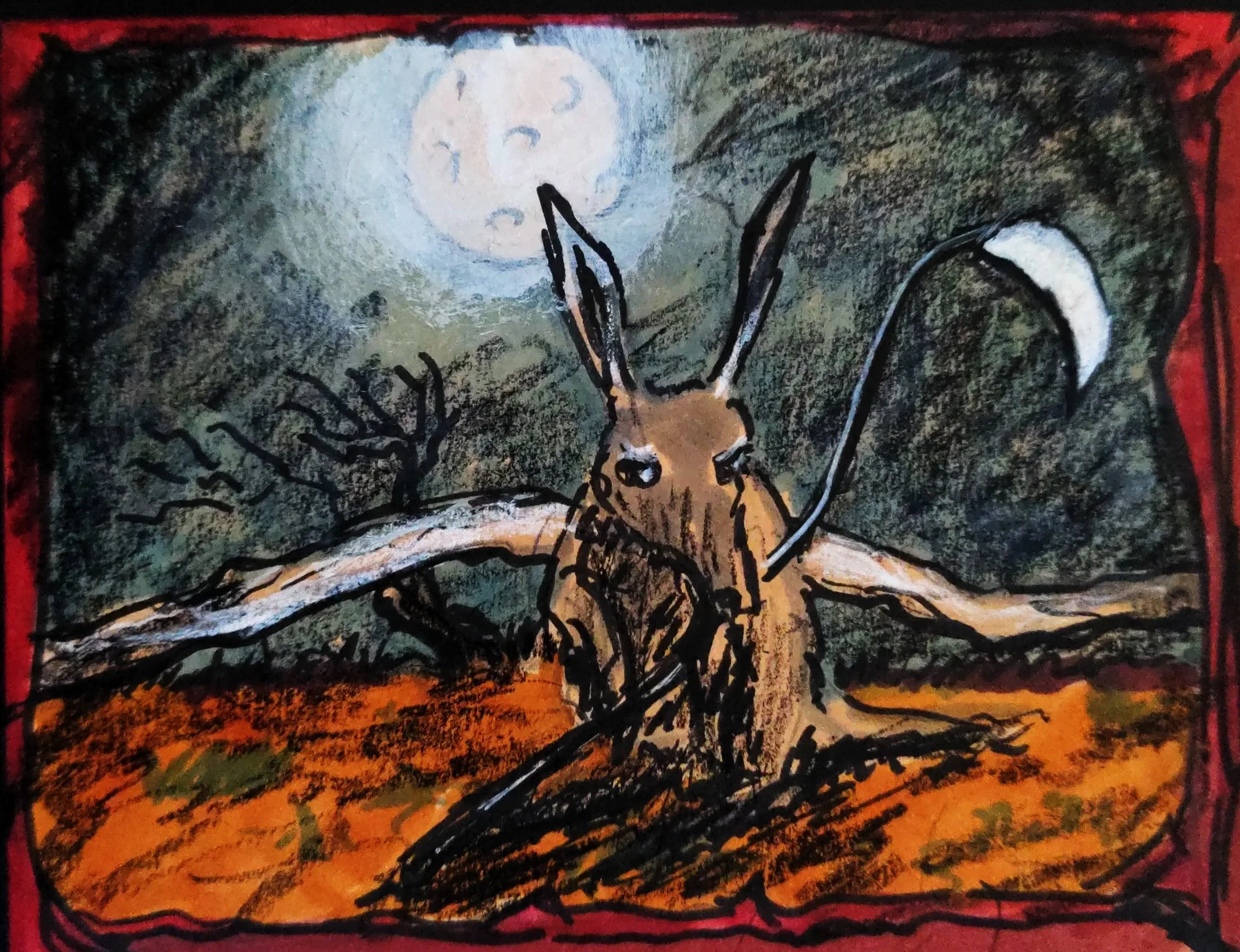
Easter, like all the imported religious holidays, seems like an awkward fit for life in Australia and its definition needs to be recalibrated for life as it is really lived here. Of course it’s hard to do this without the representatives of the various Abrahamic religions raining hate upon your head and plotting to remove it.
Because you know, the middle-east must always be the most important part of the world. Either that or Western Europe. Or Beijing. Or anywhere but where we actually live.
So in that spirit I’m gonna venture forth.
Easter’s date is chosen each year according to the LUNAR calendar.:
Easter is celebrated on the first Sunday following the Paschal Full Moon(an ecclesiastical approximation of the first full moon) on or after March 21, which represents the vernal equinox. Because this full moon changes dates annually, Easter is a movable feast falling between March 22 and April 25.
Thanks Ai, you’ve come through for me once again.
Like Christmas, the date each year is largely in agreement between Catholic and Protestant Christian denominations, although the Eastern Orthodox Rite celebrates a week or two after.
If you listen to as much SurviveTheJive as I do, then you’ll know that in medieval Europe, for many centuries, Christianity was most seriously observed/enforced by the ruling elite, with the peasantry being more devoted to pre-Christian pagan folk beliefs than conventional history really lets on.
When it came to devotional/festive days of the year, the Church generally superimposed their own myths and archetypes over the existing pagan framework. I suppose that was the easiest way to keep the show rolling without resorting to bloodhsed. Because to kill all the peasants meant no farming of the crops. You might make an example of a few but it was resource intensive and they mus't’ve eventually opted for the old-switcheroo as an easier alternative. Plus Christianity can come off a bit gay sometimes and the warrior-class (knights and palace guards) probably needed the badass element of paganism to get the blood going, hence the church militant.
Im not an accredited historian here, just an enthusiast. But this is how it makes sense to me.
Thus we come to Easter.
To quote GoogleAi Overview:
The 2026 Pink Moon (April's full moon) peaked on April 2, 2026, marking the first full moon of spring in the Northern Hemisphere. Despite its name, the moon did not appear pink, but was named after early blooming creeping phlox wildflowers. It is also known as the Paschal Moon, Sprouting Grass Moon, or Egg Moon.
If you arwe a bit suss on that one, you should be, as the source might be some American bimbos instagram feed.
At least crosscheck it against wiki:
The modern English term Easter, cognate with German Ostern, developed from an Old English word that usually appears in the form Ēastrun, Ēastron, or Ēastran; but also as Ēastru, Ēastro; and Ēastre or Ēostre.[d] In the 8th century AD, Anglo-Saxon monk and scholar Bede recorded in his The Reckoning of Time that Ēosturmōnaþ (Old English for 'Month of Ēostre', translated in Bede's time as "Paschal month") was an English month, corresponding to April, which he says "was once called after a goddess of theirs named Ēostre, in whose honour feasts were celebrated in that month".[34]
In Latin and Greek, the Christian celebration was, and still is, called Pascha (Greek: Πάσχα), a word derived from Aramaic פסחא (Paskha), cognate to the Hebrew פֶּסַח (Pesach). The word originally denoted the Jewish festival known in English as Passover, commemorating the Jewish Exodus from slavery in Egypt.[35][36] As early as 50 AD, Paul the Apostle, writing from Ephesus to the Christians in Corinth,[37] applied the term to Christ. It is unlikely that the Ephesian and Corinthian Christians were the first to hear Exodus 12 interpreted as speaking about the death of Jesus, not just about the Jewish Passover ritual.[38] In most languages, the feast is known by names derived from the Greek and Latin Pascha.[6][39] Pascha is also a name by which Jesus himself is remembered in the Orthodox Church, especially in connection with his resurrection and with the season of its celebration.[40] Others call the holiday "Resurrection Sunday" or "Resurrection Day", after the Greek Ancient Greek: Ἀνάστασις (Anastasis, 'Resurrection').[7][8][41][42]
Across Europe, baked goods are prominent features of Easter feasting. In Poland theres also an array of cured meats (ham and sausages) and hard-boiled eggs. You get the impression that in early-spring in Poland there wouldn’t have been a lot of fresh meat and fruit/vegetables going around. In Australia the situation is completely the opposite.
Unlike the Northern Hemisphere’s so-called Pink Moon, in the southern hemisphere this becomes The Harvest Moon.
However the meaning of the harvest moon is still imported from the northern hemisphere. To quote NASA:
The term "harvest moon" refers to the full, bright Moon that occurs closest to the start of autumn. The name dates from the time before electricity, when farmers depended on the Moon's light to harvest their crops late into the night.
Another aspect of European Easter that translates poorly to Australia is the solemn fasting obligation to only eat fish on Good Friday.
Jesus, being a fisherman and the fisher of men, has often been associated with fish, and thats how it translates to Easter. And fish, while being around in Europe, outside of the meditterraenean aren’t exactly ever anyone’s number #1 preferred staple in life. It does feel like a bit of a punishment to be deprived of the taste of beef, pork or chicken for a day. (Or more days, if you are doing Lent properly). THe way we celebrated in the Polish household-transplanted down-under, it was herrings wound up around a pickle and preserved in vinegar and oil. Or some similarly bitter and preserved conconction. This was called a rollmop. They came in jars. Holland House puts out a famous version:
Herring Fillets (42%), Water, Onions (8%) (Contains Sulphites), Vinegar, Sugar, Salt & Flavourings.
Notwithstanding the fact that sealed jars and cans are an invention of the industrial age, whoever devised Catholic fasting decrees in medieval Europe probably did not imagine the smorgasboard of fish varieties on offer in Australia (not to mention other seafoods). It hardly seems like a penance to have to stick to fish. Unless you feel like it should be bad-tasting fish preserved in Europe and shipped halfway across the world.
Even if you are sticking steafast to Christian belief, I think this is a long long way away from anything that Jesus meant, not to mention Pre-Christian European pagans…
…in a society that is increasingly doing away with lingering European attachments.
The Jews do Passover, the Muslims do Ramadan, Eastern Christians have to celebrate their easter a week later when its just another normal weekend (and they ask work/school for the extra days off on religious grounds anyway) and everyone else just enjoys a four-day holiday (pous add-ons if you fel like it) to celebrate the cult of the chocolate bunny.
In a shooting mag I was reading years ago, some old bush-bloke reminded us all of a rural-Aussie campaign to Australianize Easter. And that was to replace the Easter Bunny with the Easter Bilby. The premise being that the Bunny (aka the European rabbit) is a foreign invasive species, whereas the Bilby is an endangered native.
You still eat them of course, which isn’t exactly a great metaphor of the ideals of nature conservation, but I think it can be counter-argued that the Aborigines ate them anyway, and rumour has it still do (but on the down-low, so keep that to yourself), so we are also honouring their way of life by eating the chocolate bilby.
And by the way, despite the irony of the European once again being demonized as an invader, isn’t it intereting how it’s always us who are the ones most interested in preserving whatever’s left of pre-settlement Australia? Just saying.
I think I had one when I was a kid in the 90s and didn’t think it too flash compared to Lindt Chocolate Bunnies, but I was raised to be EuroSnob and maybe they’ve improved the formula since then.
What else do I personally do outside the eating and food prep? I make candles and read basically. Generally I spend at least some time reading religious texts. And thats generally historical analysis of how these religions came to be, pagan rituals and gods, etc. Then I read some other stuff too. It’d be great to go somewhere for a holiday but I can prety much never aford an Easter getaway, our economy geared as it is towards politicians, public servants and foreign parasites.
So there we have it. To ring in the dull grey bleakness of Autumn (at least in Victoria, in the northern states it stays sunny) I propose the anchors of this holiday here be to observe the harvest moon, eat as much fish as you bloody well like, have good fresh meat and veg on the feast days you annoint, eat an Easter Bilby if you can find one, read a bit, catch the last of the sun if it’s still around and prep for anything you need for the colder months. What god or diety should you honour? I don’t know, pick the one that fuckin’ works for you. Just don’t annoy me in your celebrations as I’m doing things my way.
If solemnity is actually needed:
Consider eating a rabbit. A real one (cook it of course, I shouldn’t have to say it but I don’t know what kind of people read this). I had it once, it is a bit like chicken. It’s a nuisance to carve up and have to deal with the small bones and scarcity of meat but it was filling enough. SO in that sense it qualifies in the “hard-but-doable” criteria that a penitential meal should be. What’s more, they are widespread in Australia, and vermin in fact.
Further on the significance of “the harvest”:
Considering the present widespread panic that the fuel shortage may collapse Australia’s farming and food-distribution sector, maybe we should lean in more to the “harvest” and food-bounty aspect of Easter. It seems like it has taken it all for granted. Just saying…