I have a book at home called The Xenophobes Guide To The Poles, written at the start of the MIllennium by one of these women who was quite utopian about the EU project. She states the phrase, that for Poles “East is East and West Is Best”.
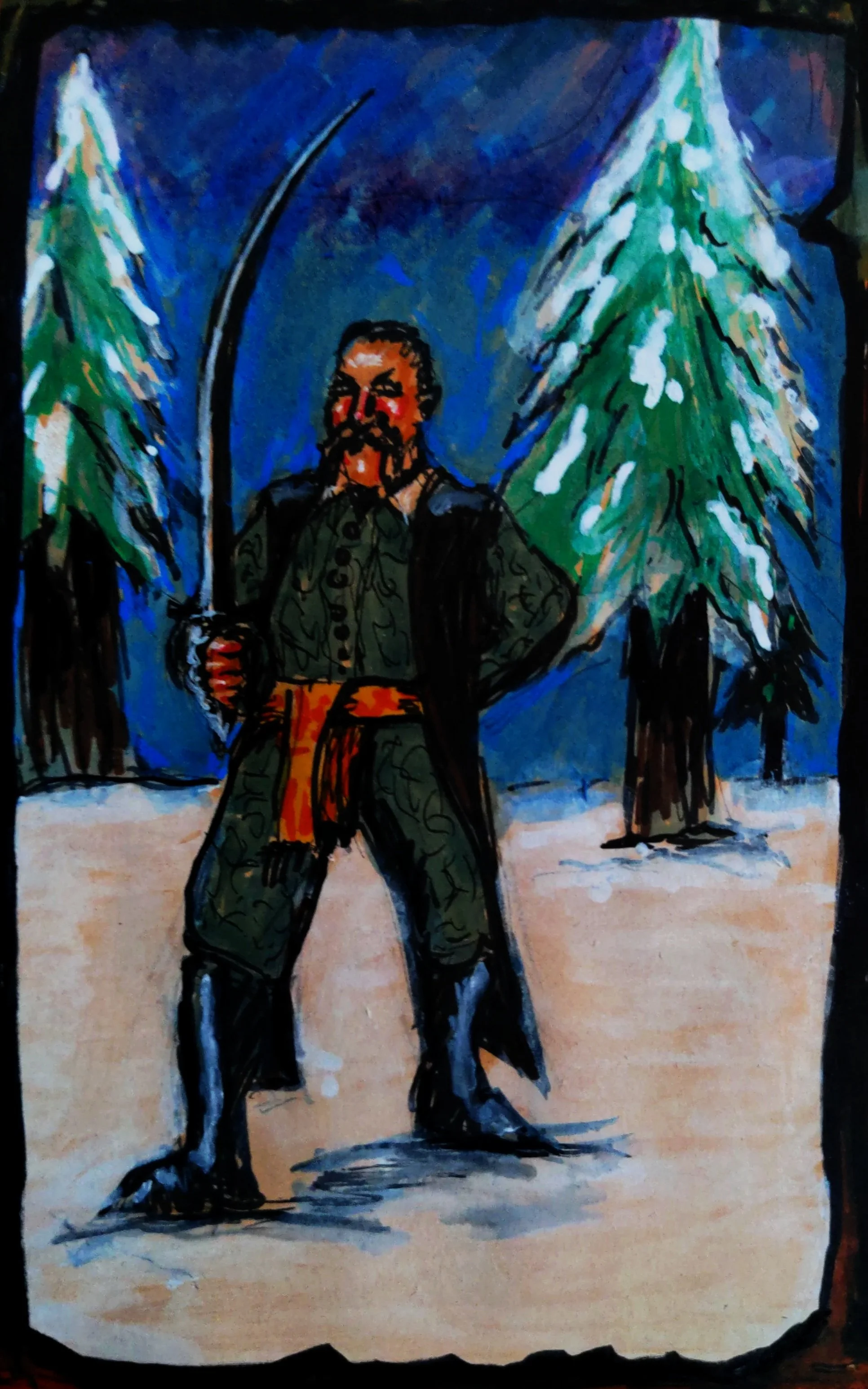
The szlachta nobleman in his folk costume (żupan), kontusz (outer coat), sash and trusty Sabre (Szabla)
I seriously call this into question and the events in Hungary on the weekend should explain why. The EU is basically a corrupt entity controlled by Soros/Merkel/Clinton and this weird new she-bitch called Ursula. It bears the character of a German matriarchy, some form of revenge for losing the first two world wars.
Orban was a stout and robust resistance to that for the last two decades. We will miss him, and hope that Meloni can be a good succeeding torchbearer for the vanguard of the European Right. I wish her well.
With the Iran war in the news I thought It would be interesting to look at the esoteric mythological concept of Sarmatism.
Sarmatism was an ideology of Poland’s Baroque-era ruling class that they descended from the steppe-nomad warriors of the steppe around what is modern-day Iran. Specifically the Sarmatians.
The wider notion is that the oriental elements of Polish culture came from the middle-east via The Caucasus, although legacies of the Ottoman Empire and the Orthodox World can also be attributed.
Think the ornate carpets, curved swords (Szablas), Turkish-style coffee, moustaches and other cultural tropes.
It’s why i think I like living in a suburb where there’s some kind of Turkish-Cypriot element that reflects itself in what’s avaliable at the supermarket and the butcher.
As a political philosophy, it inspired the Szlachtas warrior-ethos and ruling-caste mandate. They being horseback warriors were naturally a step above the rest and didn’t need to descend to the lowly level of the rural peasant.
Although you could argue that the Polish-Lithuanian commonwealths Republic (elected monarchy), which was szlachta-controlled, was better than the absolute autocracy of divine kingly rule, in effect the peasants were still diminutive and their accumulated grievances resulted in the collapse of szlachta-authority in the 19th-century partition era. You can see what I wrote about that here.
The website culture.pl has their own article on Sarmatism which is worth looking at, along with the wikis.
The Sarmatians were an ancient tribe of nomadic shepherds who, according to scholars, lived in today’s Iran in the 4th and 3rd century BCE. It is believed that in 1st century BCE the brave Sarmatians conquered lands near the Danube river and fought against the Roman Empire. It is precisely this bravery and combative attitude, as well as their love of freedom, that Polish noblemen claimed to have ‘inherited’ from their ancestors and became the foundation of Sarmatian ideology.
Roman Krzywy writes in Kultura Sarmacka (Sarmatian Culture), a publication compiled by the Museum of King Jan III’s Palace at Wilanów:
The Sarmatian myth is based on an attitude to the past that is characteristic of pre-Enlightenment eras. The times of the chivalrous ancestors are treated as if they were a sacred period. A time where one should look for examples or binding rules. Various distortions of the present can only be corrected by the return to the ideal state, not through innovation. This also applies to the ethical and personal attitudes perfectly embodied by these ancestors.
But the Sarmatian doctrine evolved: at the beginning, it only consisted of a respect for their homeland and traditions and of a readiness to defend them, even militarily if necessary. At first, it did not stand in opposition to tolerance or respect for the multinational character of the Polish-Lithuanian Commonwealth – it even served as a way to integrate the diverse society. In time – and as the result of important events, such as the Swedish Deluge – the Polish Sarmatian became a xenophobe and a religious bigot, who preferred to separate himself from the world, holed up in his manor. Late-Sarmatian culture focussed on praising the advantages of the life of the gentry, which was close to nature and family), and moved away from matters of state and politics.
Read enough about Polish Sarmatism and you come close to the martial culture of the nations golden age and also to the legendary (though apparently cruel according to revisionists) fighting nobleman Jan Crzysostom Pasek. More on him another time perhaps. I’m trying to get a hold of the memoirs.