Poletown
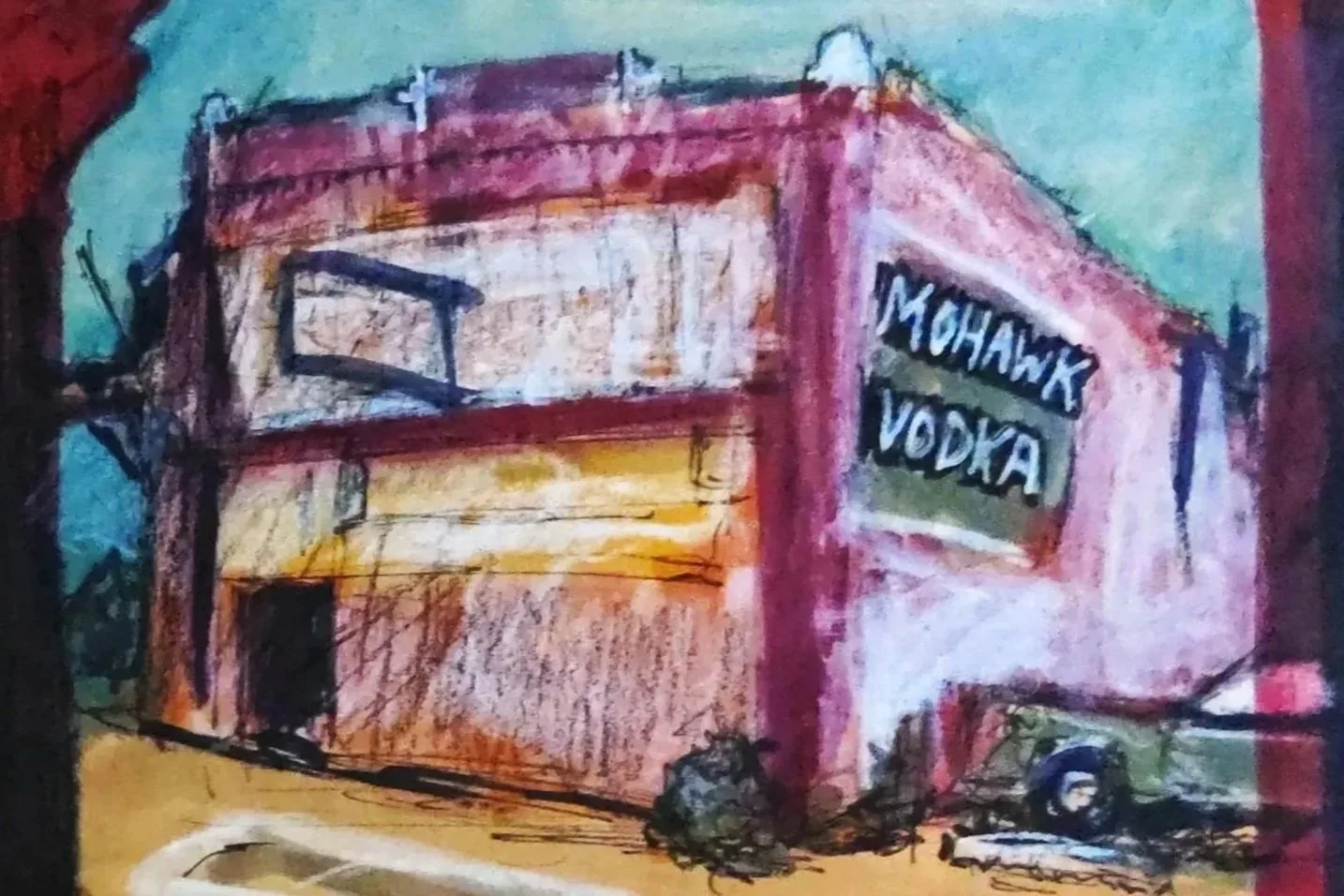
In 2008 I went to Detroit Michigan.
It was either August or September of that year, and quite literally the eve of the GFC. Lehmann Bros was going to collapse a few weeks later. I believe General Motors was already asking for money from the US Federal Government.
I was in the Renaissance Centre, up on one of the higher floors looking out the window at the city below, like some kind of scheming corporate CEO I walked all around the downtown, popped into a few abandoned buildings, and along some weedy walkpath with a couple of locals as we passed by homeless, wreckage and underpasses.
My auspices for going to Detroit was not only simple curiosity at visiting the edgier parts of the map, but to go to places that as well as being known for strife had also thrown up their fair share of cultural curiosities.
Detroit had no shortage of those.
The US Auto Industry, Various icons and scenes of popular music, Ice Hockey, the setting for movies like Robocop.
The industry, the neighbourhoods, the wreckage, the riots, all this is relatively storied.
I was there for 1 week and that was 18 years ago, but the interest has never subsided over time, only increased. I keep finding new things out.
The city’s politics and tensions seem to often be a microcosm of larger debates, and the actions and events there seem to express physically what everyone feels is to hard or uncomfortable to discuss verbally.
That brings us to Poletown.
Poletown was the Polish ethnic quarter of Detroit.
The Poles were arriving in Detroit right from the start of the 20th century. Thats when my great-grandfather was there during one of two stints as a factory security guard. He was earning money to build his house back in Niezatyce, Malopolska Poland (at the time part of Galicia in the Austro-Hungarian Empire).
Many Poles opted to stay and settle in Detroit however, and were significant enough in numbers to establish a solid imprint on the city’s cultural development. They would notably do this in other US cities such as nearby Chicago, New York and even had settlements in Texas. But the Poles of Detroit were destined for a more eventful fate.
In Detroit they established enough critical mass to have a neighbourhood named in their honour: Poletown. There were also Italian and Irish families around to reinforce the Catholic character.
They all worked in the auto factories, and thus took part in the union activism of the time aswell. These manifested most clearly in the strikes of the depression-era 1930s.
They also built a Church, established restaurants, and held parades and festive occassions honouring their Polish heritage. Detroit still infact has a Paczki day.
The old European Ethnic neighbourhoods are romanticised today but they were alot of problems for the WASPy powers that be in the early 20th century. Ethnic neighbourhoods were associated with grime (organised and otherwise), slums, sectarianism, fifth-columns that undermined US foreign policy, a threat to the mainstream and an expense on the bottom-line of the elite. Reasons such as this were why US congress voted to severly limit immigration in the 1920s until the 1960s when they were relaxed again.
The ruling class had another latent underclass which was the southern-US Black Americans.
Men like Henry Ford and other industrialists and civic planners had determined that enticing the Blacks to move north would solve two problems at once:
-In their view at the time, compliant black Americans would be less willing to strike, and they were deemed more compliant because they were former slaves. This was better for the company bottom-line.
-Inserting a black presence in the white catholic migrant communities would break the social cohesion of the latter, undermining their own power-base.
So the Blacks were bussed north. Above what they called the Mason-Dixon line. Southern Rural Blacks became Northern Urban Blacks. For their part they saw this as a welcome new opportunity having become frustrated at the Jim Crow laws and persisting discrimination culture of the Post-slavery South.
The white ethnics of cities like Detroit were aware of what was going on though, and didn’t like their own tenuous place in in the New World being undermined. In fair hindsight, both groups were equally like pawns on a chessboard, but try telling them that at the time. Right from the outset there were clashes, hostiliy, crime, actions and retributions. This occured in the factories, in the streets and in common civic spaces like the school commutes.
On top of all this, the US experience of WW2, when the nation was drawn in to save Western Europe from Nazi Germany, established the prevailing narrative that white racism was the ultimate evil. This narrative became further entrenched by the postwar Black Civil Rights movement. Martin Luther King himself went to visit Detroit.
The ethnic Poles of Detroit found themselves up against the world without a voice of sympathy. Too ethnic to be mainstream, too white to be an underclass. Their concerns were essentially ignored and dismissed as an ignorant old prejudice. Local Police in many situations seemed to sympathise with the Polish predicament in Detroit, for they observed the civil behaviour of the varying groups and were responsible for fighting crime and maintaining law and order. They deemed the Poles well-behaved and fundamentally law-abiding. To Blacks this appeared like prejudice, and the new postwar narrative was increasingly telling them that they were the victims of historical racism from whites. A white’s a white afterall, whether from Poland (a country that spent the whole of the 19th century occupied and had continued to endure immense hardships under Nazism, then Communism) or any other white group. It got simplified into “white = colonial oppressor vs black = colonised/enslaved victim”. The local police were deemed by the politicians and the national press to be racists and were increasingly over-ruled by judges, state troopers, activists etc.
In 1967 things came to a head and race riots broke out in Detroit. The city-centre and surrounding neighbourhoods were destroyed, the optics broadcast nationwide (during the “long hot summer of ‘67” where there would be over 150 riots in cities across the US in a single year), and what followed was the hollowing out of Detroit’s ruined centre. The famous “white-flight” was on as white families fled to the suburbs further out to escape the black inhabitants of the inner-city and their associated criminal elements.
By this point the Blacks had coalesced into a political bloc of their own and had gained power in the local legislatures (AKA City Hall).
The first Black Mayor was elected: Coleman Young. He’s a man who deserves an article of his own and I intend to write one down the track.
Coleman Young would hold power in Detroit from the 1974 until the 1994 and his reign continues to divide people. Was he trying to stem a declining city or was he actually accelerating the decline with his own policies?
Whatever you think of him, his face seems somehow familiar as the persona of the black city-mayor restlessly trying to manage a socially fractuous and combustible US city in the late 20th century. It seems like he’s been the inspiration for a hundred movies, tv shows and video games.
They say Coleman Young had it in for Poletown and that he didn’t like the Poles very much. That he wanted to expediate their departure from the city. His defenders respond that Poletown was already in decline, the Catholic Parish was going to be decommisioned, and the city urgently needed new development and investment.
GM needed a new factory and Poletown was seen as a good spot. Acquire the old neighbourhood by eminient domain, evict the residents, knock it all down, build the new factory (to be known as Factory Zero) and prop up the ailing auto industry with new jobs.
And that’s what happened, the merits of which are still hotly debated today, including among many people who grew up in Detroit but left.
The demolishing of the Polish Church is an ugly sight to see in the photos if you can find it (which I struggle to outside of the Substack article mentioned below that inspired this write-up), but I suppose me being far away in time and place from these events I can rationalize a lot of all this. I’m writing about this incident to demonstrate that racism against whites is real, not new, and no “better” than what occurs against other groups. Poles, by virtue of circumstance seem particularly affected (witness Henry Nowak’s recent murder in the UK). Both me and my dad have had the race card played against us. I can attest to the fact that when it happens to us and we try to speak about it, that somehow we are just not taken very seriously.
I was inspired to write this by an article shared on Substack, written by Adam Schmidt and John Carter. They referenced a book that I now have on my reading list called The Slaughter Of Cities by E. Michael Jones.
It’s always good for people to get different sides of the story. As Oprah Winfrey would say: “Speak Your Truth.” Which of course makes you an opinionater or journaler, rather than a factual correspondant. But your opinions and experiences are still part of the body of evidence, even if they are not conclusive and must be weighed against those of others and other forms of evidence.