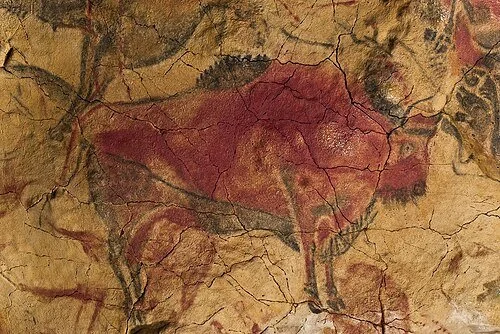
The bison as depicted by prehistoric artist(s) in the Cave of Altamira, Spain
A descendent of the same animal depicted in prehistoric cave art in Spain, it is the largest wild land mammal still existent in Europe, and inhabits the last of Europe’s primeval forest that once covered the continent but is now only found in an area spanning the border of Poland and Belarus. The forest and the bison population have had some form of legal protection since the middle ages, and arguably this might be the oldest environmental legislation on record anywhere in the world. From the Białowieża (pronounced: biawoviezja) wiki:
The protection of bison stretches back to at least 1518, when some nobles were granted hunting privileges in the forest, but not for bison.[20] Another notable piece of legislation on the protection of the forest dates to 1553, when a document issued by Sigismund I instituted the death penalty for poaching a bison.[21] The King also built a new wooden hunting manor in a village of Białowieża, which became the namesake for the whole complex. Since Białowieża means the "white tower", the corresponding Puszcza Białowieska translates as the "forest of the white tower". The Tower of Kamyenyets on the Belarusian side, built of red brick, is also referred to as the White Tower (Belaya Vezha) even though it was never white, perhaps taking the name from the pushcha.[22]
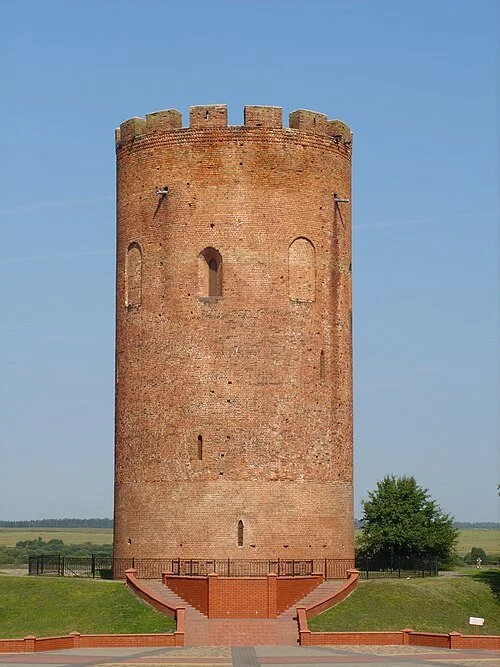
The Tower Of Kamieniec/Kamyenyets, Belarus. It should be noted that the Polish word “Wies” translates as “Village”, and Biało is white. taken together: “White Countryside”, if you accept googles translation. Białorus is the Polish name for Belarus. I flew on an Austrian airline (Lauda Air?) on my last trip to Europe and Belarus was marked on the maps as White Russia, as their German translation to English. The tower is clearly red and medieval people, though mostly illiterate, were no stupider than people are today. I believe the correct origin of the name Puszcza Białowieska SHOULD be “Forest Of The White Countryside, not Forest of The White Tower. The -ski/ska suffixes are for adjectives. Formed as a noun, Białowies is probably really “White Village”, where a village can be a loose collection of dwellings within a forest, Kindof how you used to see in medieval fantasy RPG video games. Because language was mostly spoken and heard, not written, it seems to me that the meanings can be more fluid and casually applied than we modern hyper-literate types are comfortable with. This is also the north-east of Europe, often blanketed in white snow. Anyway, side-quest over, back to the main article.
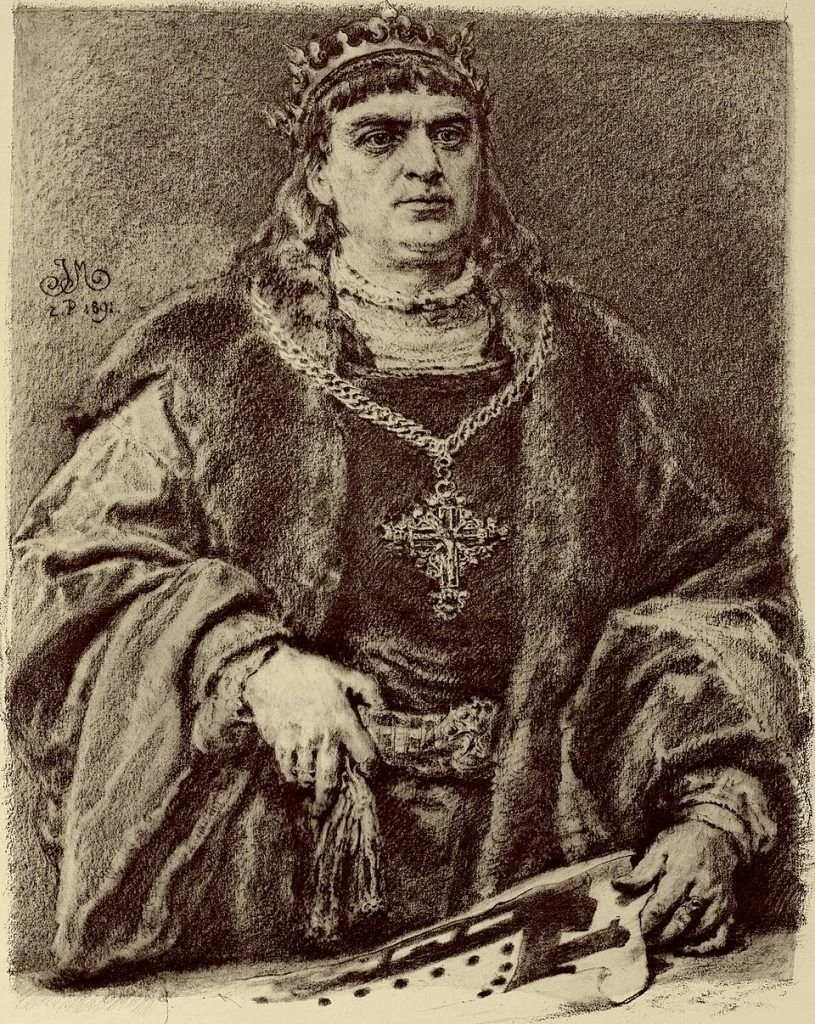
King Zygmunt I Stary (Sigismund I The Old), who in 1553 AD threatened the death penalty for anyone who poached a żubr. Here he is as depicted by 19th century historical and portrait painter Jan Matejko.
SO there you go, beating out the anglosphere for environmental protection by a couple of centuries, and also possibly the first and only death penalty on the books as punishment for killing a protected animal species. I’m not sure if it was ever carried out.
This same passage also notes the forests role in an early form of serf emancipation.
In 1557, the forest charter was issued, under which a special board was established to examine forest usage.[23] In 1639, King Vladislaus IV issued the "Białowieża royal forest decree" (Ordynacja Puszczy J.K. Mości leśnictwa Białowieskiego). The document freed all serfs living in the forest in exchange for their service as osocznicy, or royal foresters. They were also freed of taxes in exchange for taking care of the forest.[24] The forest was divided into triangular areas called (straże), with their center in Białowieża. By the end of the 18th century, there were 13 such areas.[25]
They have been precariously protected ever since then, and numbers have fluctuated but remained usually in the hundreds, though the period of Poland’s foreign occupation did great harm. Their present era enjoys numbers in the low thousands.
As for times when Poland was under foreign occupation, The Russian Empire had a mixed record with conservation efforts mixed with timber industry development and imperial hunting fashions, and the era punctuated by wars and uprisings. Nevertheless Alexander I and Nicholas II showed a better environmental track record than you might expect for their era. Bans and protections were upheld, surveys and studies were taken, an ongoing caretaker presence was maintained:
In 1795, as a result of the Third Partition of Poland, the forest fell under Russian control. The land, along with the foresters living there, was given to Russian generals.[29] Forest protection collapsed, leading to logging and poaching.[30] Local authorities reported that fewer than 200 bison remained alive,[31] a drop from 300 at the end of Polish rule.[32] Bison protection and the foresters' former privileges were restored in 1802, after Alexander I ascended to the throne.[31] Consequently, the number of bison grew to 350 by 1809 and 772 by 1830.[33] Hunting without royal permission was completely banned in 1820,[34] leading to an increase in the wolf population. Wolf hunting was then permitted in 1829 and later even received government funding.[35] Another change introduced by Russian authorities was strengthening fire protection. This led to the replacement of small, regular fires with rare, large ones, which occurred three times in the early 19th century: in 1811, 1819, and 1834.[36] The forest was only partially affected by the Napoleonic Wars with the main battles taking place outside of it.[36]….
……
….In 1888, the forest was transferred to the direct control of the Ministry of the Imperial Court, effectively turning it into the Emperor's private hunting reserve.[46] Upon its transfer, a royal palace, park, roads, and a railway were constructed, along with an administrative building and apartments for the forest administration.[47] In the 1890s, authorities successfully reintroduced red deer, which had been extinct in the area.[48] Nicholas II aimed to preserve the forest's primeval appearance, limiting tree cutting and opening a natural history museum of the forest in 1914.[49] The last Russian royalty visit was by Nicholas II in 1912.[50]
During the period of Russian rule, 153 bison were hunted for recreational purposes, 56 for scientific study, and 72 were captured alive for zoos, cross-breeding, or taming experiments. Sometimes such transfers were hindered by political conditions, such as the deterioration of Franco-Russian relations in the 1860s, which resulted in a bison not being sent to Strasbourg.[51]
The German military were probably the worst thing to ever happen to the forest and the żubr, and its looks as though they actively tried to wipe the Bison out when they were occupying the area in WW1. Though it seems none-other-than Hermann Göring and even Stalin might have had a role in keeping the bison’s story alive. Here the conservation story and the political story get even more intertwined:
During World War I, occupying German troops killed 600 of the European bison in the Białowieża Forest for sport, meat, hides and horns.[38] A German scientist informed army officers that the European bison were facing imminent extinction, but at the very end of the war, retreating German soldiers shot all but nine animals.[38][39] The last wild European bison in Poland was killed in 1921. The last wild European bison in the world was killed by poachers in 1927 in the western Caucasus. By that year, 48[41] remained, all held by zoos. The International Society for the Preservation of the Wisent was founded on 25 and 26 August 1923 in Berlin, following the example of the American Bison Society. The first chairman was Kurt Priemel, director of the Frankfurt Zoo, and among the members were experts like Hermann Pohle, Max Hilzheimer and Julius Riemer. The first goal of the society was to take stock of all living bison, in preparation for a breeding programme. Important members were the Polish Hunting Association and the Poznań zoological gardens, as well as a number of Polish private individuals, who provided funds to acquire the first bison cows and bulls. The breeding book was published in the company's annual report from 1932. While Priemel aimed to grow the population slowly with pure conservation of the breeding line, Lutz Heck planned to grow the population faster by cross-breeding with American bison in a separate breeding project in Munich, in 1934.
Heck gained the support of then Reichsjägermeister Hermann Göring, who hoped for huntable big game.[42] Heck promised his powerful supporter in writing: "Since surplus bulls will soon be set, the hunting of the Wisent will be possible again in the foreseeable future". Göring himself took over the patronage of the German Professional Association of Wisent Breeders and Hegers, founded at Heck's suggestion. Kurt Priemel, who had since resigned as president of the International Society for the Preservation of the Wisent, warned in vain against "manification". Heck answered by announcing that Göring would take action against Priemel if he continued to oppose his crossing plans. Priemel was then banned from publishing in relation to bison breeding, and the regular bookkeeper of the International Society, Erna Mohr, was forced to hand over the official register in 1937. Thus, the older society was effectively incorporated into the newly created Professional Association. After the Second World War, therefore, only the pure-blooded bison in the game park Springe near Hanover were recognised as part of the international herd book.[43][44]
The first two bison were released into the wild in the Białowieża Forest in 1929.[45] By 1964 more than 100 existed.[46] Over the following decades, thanks to Polish and international efforts, the Białowieża Forest regained its position as the location with the world's largest population of European bison, including those in the wild.
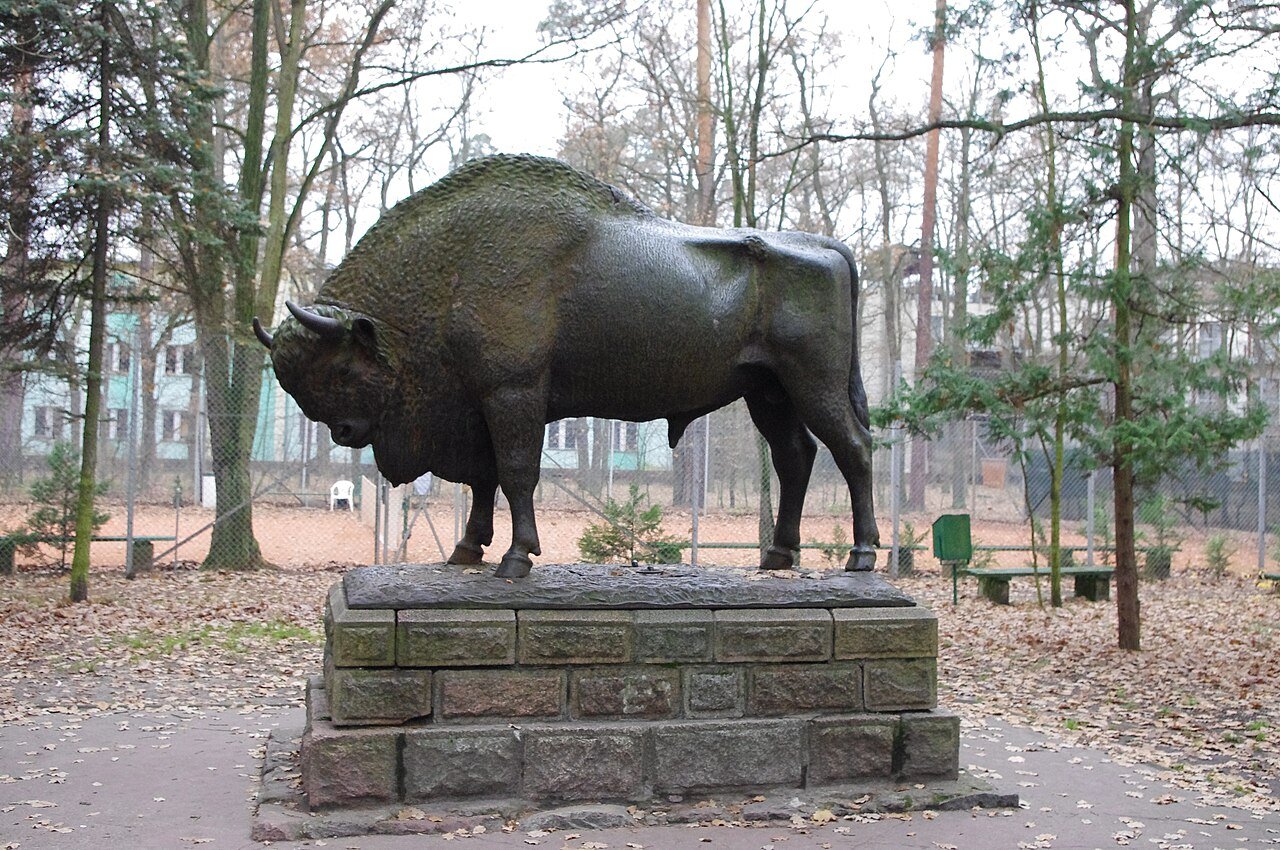
A fine żubr sculpture if ever I saw one. This one is found in the town of Spale in the voivodship of Łódź. It was originally erected in Zwierzyniec, a town in the Białowieża Forest to commemorate a hunt organised by ALexander II in 1862, so maybe not the best motives in modern terms to erect a statue, but still impressive nonetheless.
As you can see, despite the valiant conservation efforts over the centuries and even during the Polish partition era, when Poland regained independence in 1918 they found that the German occupation troops of WW1 had totally wiped them out of the forest. Thankfully specimens were located in zoos worldwide, and a certain żubr from a single town in southern Poland, who was the offspring of a pair gifted to the local duke by Tsar Alexander II, is the sire for a large part of the population that now exists.
The re-established population was complimented by near-relatives in forests found in the Russian Caucasus (who have ironically now gone extinct themselves). The żubr population of the Białowieża has recovered significantly since the end of WW2 and especially since the end of the USSR in 1991. Even though the following wikipedia excerpt is similar to the above, it comes from the Białowieża page rather than the European Bison page and enlightens some facts that weren’t in the above passage. Do a skim if you will:
During World War I the forest suffered the greatest losses to the forest in history.[52] German troops, part of the 9th Army commanded by Prince Leopold of Bavaria, entered Bialowieza and the forest on August 17, 1915.[53] In order to use the forest for military purposes, the Bialowieza Military Forestry Administration was established, headed by Major Georg Escherich. The German occupation of the area lasted until December 1918.[54] During this period, the forest experienced extensive timber extraction: of the forest's estimated abundance of 32 million m3 of timber, 5 million m3 were cut down.[55][b] During three years of German occupation, six sawmills were built and 250 kilometres (155 miles) of railway tracks were laid in the forest to support the local industry.[55] The German army also started to hunt the animals. By September 25, 1915, the bison population had decreased from approximately 700 to 200, which prompted the issuance of an order forbidding hunting in the reserve.[57] However, German soldiers, poachers and Soviet marauders continued the slaughter until February 1919 when the area was captured by the Polish army.[58] The Polish government proclaimed that the last bison had been killed before the army's arrival, but there are claims that bison were present in the forest in April 1919 or even in 1921.[59][60] Thousands of deer and wild boar had also been shot.[61]
After the Polish–Soviet War in 1921, the core of the forest was declared a National Reserve.[62] In 1923, Professor Józef Paczoski, a pioneer of the science of phytosociology, became a scientific manager of the forest reserves in the Białowieża Forest. He carried out detailed studies of the structure of forest vegetation there.[63][64][65]
In 1923 it was known that only 54 European bison survived in zoos all around the world, none of them in Poland.[66] In 1929, a small herd of four was bought by the Polish state from various zoos and from the Western Caucasus (where the bison was to become extinct just a few years later). These animals were of the slightly different Caucasian subspecies (Bison bonasus caucasicus).[67] To protect them, in 1932 most of the forest was declared a national park.[68] The reintroduction proved successful, and by 1939 there were 16 bison in Białowieża National Park.[69] One of them, a male from the zoo in Pszczyna, is the founder of almost the entire population of bison that inhabits the forest,[70] he was descendant of a pair given to the Duke of Pszczyna by Tsar Alexander II in 1865.[71]
In 1939 the local inhabitants of Polish ethnicity were deported to remote areas of the Soviet Union and replaced by Soviet forest workers. In 1941 the forest was occupied by Germans and the Russian Soviet inhabitants were also expelled. Hermann Göring planned to create the largest hunting reserve in the world there. After July 1941 the forest became a refuge for both Polish and Soviet partisans and Nazi authorities organised mass executions. A few graves of people who were killed by the Gestapo can still be seen in the forest. (Hermann Göring directed anti-partisan operations by Luftwaffe security battalions in the Białowieża Forest between 1942 and 1944 that resulted in the murder of thousands of Jews and Polish civilians.)[72] In July 1944 the area was overtaken by the Red Army. Withdrawing Wehrmacht troops demolished the historic Białowieża hunting manor.
After the war, the forest's territory was divided between Poland and the Belarusian SSR of the Soviet Union. The chairman of the Polish Committee of National Liberation, Edward Ochab, wrote in his memoirs regarding the negotiations about the demarcation of the border in the area of Białowieża Forest. According to his view, the Soviet officials repeated many times that they were not interested in enlarging their vast state, but only in sorting out the issue of Belarusian and Ukrainian nationalities in the borderland area (Kresy). Ochab emphasized to his Soviet negotiators that the problem didn't exist in Białowieża Forest and that the forest had a special historical place in the Polish national memory as a place where guerilla fights took place during the uprising against the tsarist regime. In addition, Poland had its forests decimated by the Germans during the occupation of Poland and finally, the forest was Poland's raw material basin for the timber industry in Hajnówka. According to Ochab's memories, when Stalin fiercely insisted on the need to "close the case", Ochab requested a break for consultations in the nearby room. He told his associates from the PKWN that he would resign from his position as the chairman of that body, as he could not find enough spiritual strength and inner conviction to promote Polish–Soviet friendship. The conversation was interrupted and the delegation was escorted to the premises in the seat Union of Polish Patriots and waited for news from the Soviet government. After a half an hour or so, Soviet Foreign Minister Vyacheslav Molotov called and informed Ochab by phone that Stalin had agreed to transfer half of the forest to Poland including the village of Białowieża and congratulated him. According to Ochab, he was unhappy with the decision as he was counting on the entire Białowieża Forest.[73]
The Soviet part was put under public administration while Poland reopened the Białowieża National Park in 1947.[62] Belovezhskaya Pushcha was protected under Decision No. 657 of the Council of People's Commissars of the Soviet Union, 9 October 1944; Order No. 2252-P of the USSR Council of Ministers, 9 August 1957; and Decree No. 352 of the Byelorussian SSR Council of Ministers, 16 September 1991.[74]
In December 1991, the Belavezha Accords, the decision to dissolve the Soviet Union, were signed at a meeting in the Belarusian part of the reserve by the leaders of Ukraine, Russia and Belarus.[75]
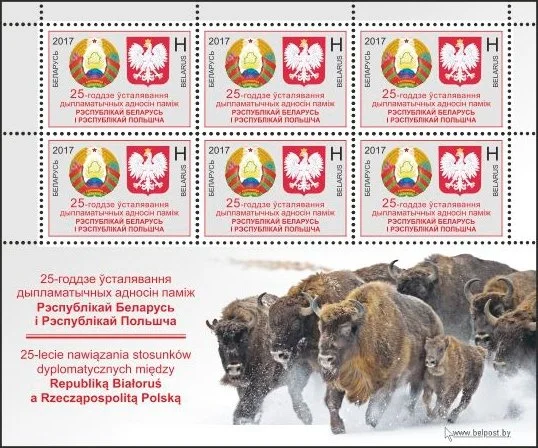
The Belarusian Postage Stamp Sheet commemorating Polish-Belarussian relations that was released in 2017, during happier times before the breakout of the current Ukraine War. Source.
There’s a lot more to say. The difference between the European and American Bison for instance:
Although superficially similar, a number of physical and behavioural differences are seen between the European bison and the American bison. The European bison has 14 pairs of ribs, while the American bison has 15.[63]
European bison has a lankier body than the American bison (Tallinn Zoo, Estonia, 2023 March)
Adult European bison are (on average) taller than American bison, and have longer legs.[64] European bison tend to browse more, and graze less than their American relatives; to accommodate this their necks are set differently. Compared to the American bison, the nose of the European bison is set further forward than the forehead when the neck is in a neutral position.
The body of the wisent is less hairy, though its tail is hairier than that of the American species. The horns of the European bison point forward through the plane of their faces, making them more adept at fighting through the interlocking of horns in the same manner as domestic cattle, unlike the American bison, which favours charging.[65] European bison are less tameable than the American ones, and breed with domestic cattle less readily.[66]
The European bison is less shaggy, with a more lanky body shape.[67]
In terms of behavioural capability, European bison runs slower and with less stamina yet jumps higher and longer than American bisons, showing signs of more developed adaptations into mountainous habitats.
There’s other stuff to mention too. Such as The Żubroń, which is a hybrid of a żubr and a cow that was developed by a mysterious Pole named Leopold Walicki in 1847, for a variety of obvious reasons that shouldn’t have to be mentioned.
And let’s not forget one of the most famous żubr who ever lived: Pubal. He probably deserves an article of his own. And then there is the world-famous Żubrówka (pron: zjoo-broov-ka) vodka. I’ll leave it there for now as taster for next time. Żubroń everyone, Żubroń…
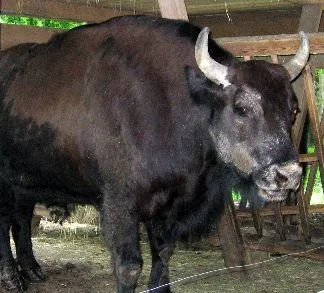
The great and glorious Żubroń, part żubr, part cattle. Designed in 1847. Proudly made in Poland. Source.
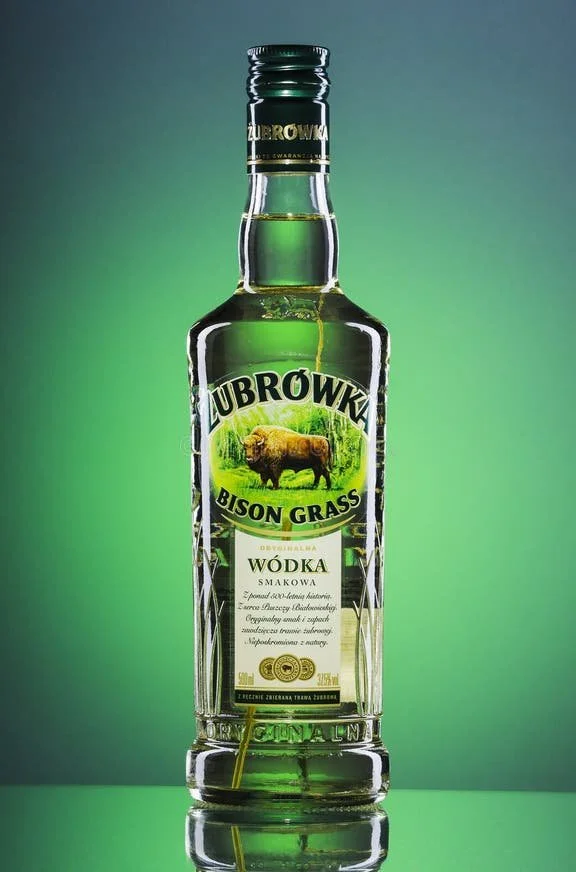
The world-famous Żubrówka Bison-Gras vodka, which comes in several flavours these days. It looks like the Tower Of Kamieniec. Image Source.
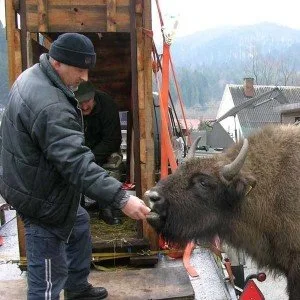
One of the most famous żubr who ever lived, if not the most famous of all: Pubal. Source