Preface
Zerohedge was experiencing serious outages on the day I began this article, and no one seems very sympathetic, even though this website has done so much heavy lifting for the alt-right, MAGA and prepper movements. Its been my favourite news site of the last 11 years and has changed my life.
Search the wiki and it is still introduced as a “far-right” website even though it’s editorially neutral on many matters. It’s just that it published what others chose not to, thus revealing to the public what they would try to conceal from you. This relates to GFC, the EUs many hypocrisies and microtyrannies, Wikileaks, Trump, Brexit, Covid and the vaccine scams, US Election fraud from the HIlary Deepstate, the stupidity of Australia's governing class, the rising hegemony of China, silicon valley trends, tech-wars, Meta/X/Telegram, AI and Drone development, migration patterns and so on. Good and useful stuff to know if you want to preserve your future. No wonder they want it shut down.
Zerohedge is run by ABC media (no relation to Australia’s ABC) which is owned by the father of the site editor: Daniel Ivandjiiski .
Even the wiki article seemingly can’t cease to hang shit on him at every opportunity:
The New Republic and New York magazine have identified Daniel Ivandjiiski as the founder of Zero Hedge.[1][7] The New York article made assertions regarding Ivandjiiski's background, particularly his Bulgarian citizenship, his FINRA charge and lifetime ban from securities trading, and his father, Krassimir Ivandjiiski's, own controversial news and political website, Strogo Sekretno (Bulgarian: Строго секретно; English "Top Secret"),[a] and Krassimir's position in the pre-1990 Bulgarian-Soviet administration".[b][7]
On 29 April 2016, an ex-employee of Zero Hedge, Colin Lokey, who had joined a year earlier in 2015 from Seeking Alpha, gave an interview to Bloomberg, revealing Ivandjiiski, and San Francisco-based credit trader Tim Backshall,[c] as the main force behind Zero Hedge.[9][10] The article confirmed various details about Daniel Ivandjiiski, including that he lives in a mansion in Mahwah, New Jersey, Lokey saying: "These two guys, who live a lifestyle you only dream of, are pretending to speak for you."[11]
What if I told you that that was probably true, but also unfair, out of context and irrelevant to the site’s good work? Libertarians and capitalists don’t mandate altruism and believe money should be seen as a positive, or at least not negatively. Some Libertarians do seem to want to be poor, but that’s another story. You can live in a mansion if you want to, that in and of itself is not against the rules and a rich person giving financial advice and tips to benefit people who also want to generate wealth is quite a generous thing for a Libertarian to do.
I can’t help but feel there’s a lot of anti East-Europeanism around. Its kind-of like a form of racism without the legitimacy of having a different colour, as its one kind of white people shitting on another kind of white people and getting away with it.
Anyway, Daniel Ivandjiiski is Bulgarian by background, and the blog has a distinct East-European temperament, and I think that’s a big part of what is misunderstood about that sites editorial tone, As Easterns are not Westerners. There’s always misunderstandings. I see myself increasingly as an explainer of East Europe and cultural communicator, among the other crap I do here. So let’s talk about the Bulgars. This is an emphasis on the ancient Bulgars btw.
Introducing The Bulgars:
Below is a bunch of wikilinks if you want to do as deep a dive as I did.
But the overview is that there is more to them than meets the eye. Apart from the fact that places like Sofia and Plovdiv look very nice and scenic.
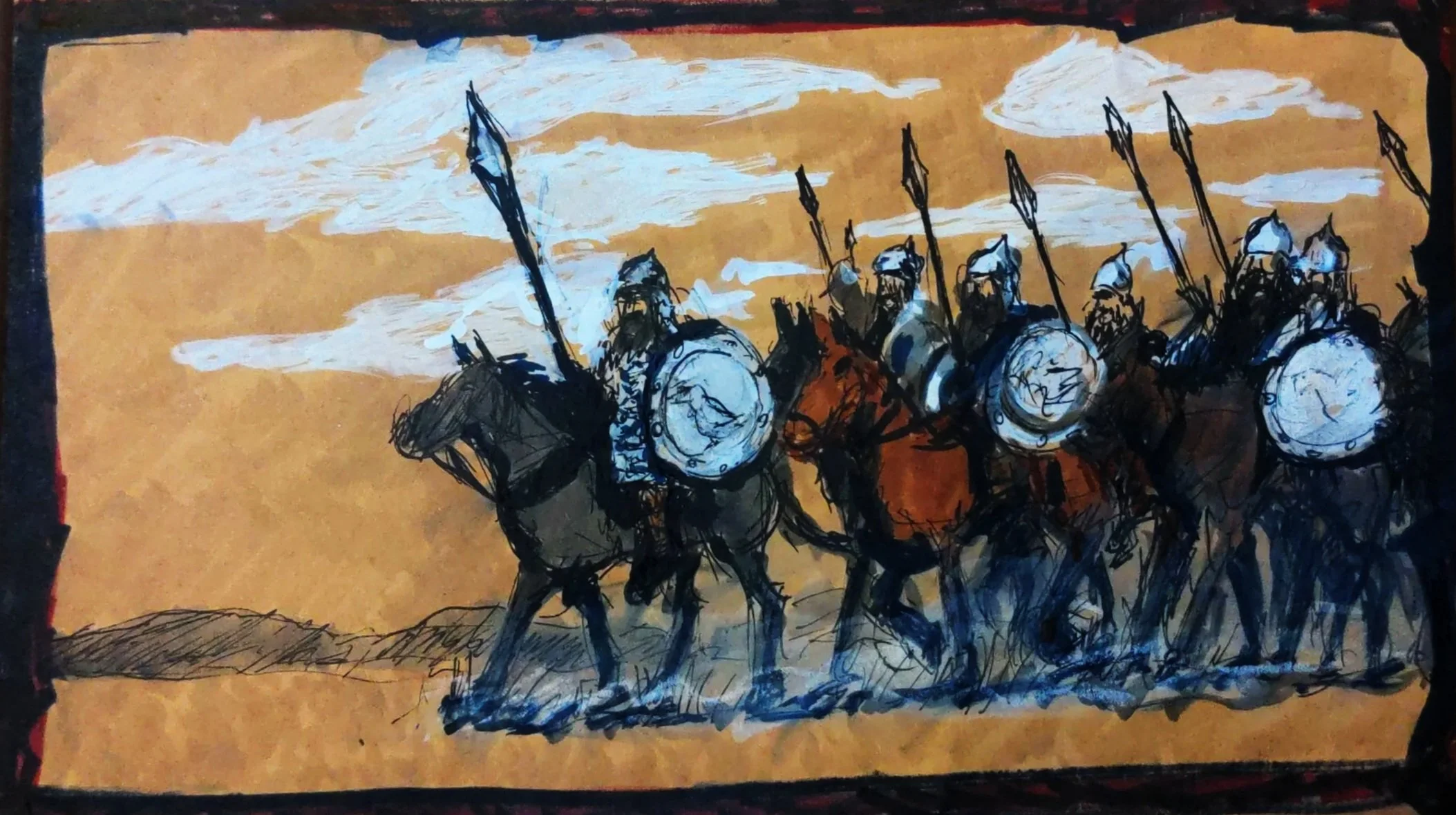
The Bulgars entered the historical records initially as a Turkic steppe-nomad people migrating from central Asia.
They arrived in their rough present location around the 6th or 7th century and got the notice of the Eastern Roman (Byzantine) empire, who didn’t think much of them naturally.
There was a First Bulgarian Empire under a leader named Krum (sometimes known as Khan Krum), A Second Empire, wars with the Byzantines and Ottomans, a Bulgarian Calendar, a mysterious religious system named Tengrism, and somehow during the rises and falls in the battle for permanency they absorbed Slavic inhabitants and adopted their language. So even though Bulgaria is named after a nomadic horse-warrior people from Asia, they are considered essentially Slavic culturally and linguistically, with a genetic makeup that is around 55% Paleo-Thracian, 40% early Slavic and only 2.3% Central Asian (the part of the world the Bulgar tribe originated from).
Below are all the links that filled my tabs-bar as I was researching this, and Robin Pierson’s History Of Byzantium podcast has also featured the Bulgars in a cameo role throughout the years.
https://en.wikipedia.org/wiki/Bulgars
https://en.wikipedia.org/wiki/Krum
https://en.wikipedia.org/wiki/Tengrism
https://en.wikipedia.org/wiki/Western_Turkic_Khaganate
https://en.wikipedia.org/wiki/Bulgar_calendar
https://en.wikipedia.org/wiki/Nominalia_of_the_Bulgarian_Khans
https://en.wikipedia.org/wiki/Kuber
https://en.wikipedia.org/wiki/First_Bulgarian_Empire
https://en.wikipedia.org/wiki/Lombards
https://search.brave.com/images?q=what+weapons+did+the+early+bulgars+use
The steppe-nomad life is no longer around, but there is a lot that links the cultures of the nations that inherited the geography on which they roamed. And not just history. The current wars in Ukraine and Iran notwithstanding, it seems like a lot of the worlds economic energy and dynamism now comes out of the west Eurasian steppe and the lands surrounding it, which include Easern Europe, The Middle East, The Caucasus, East Asia, Russia, India, The Stans, etc.
Diving Into The History:
The Bulgars first come into view in the late 5th century and established themselves in their present location by the 7th century, when they moved into the west Black Sea area from the north side and Sea of Azov, an area known as “Old Great Bulgaria”, which is also now what historians call the early Confederation of Bulgar Tribes, believed to have been founded by Kubrat in around 632 AD.
In the Nominalia of the Bulgarian khans Kubrat is mentioned as Kurt (Коуртъ), being a member of the Dulo clan and reigning for 60 years having succeeded Gostun of the Ermi clan.
Bulgars were Turkic nomadic people, who participated in the 5th-century Hunnic confederation. Upon Attila's death, the tribes that later formed the Bulgars had retreated east into the Black Sea-Caspian Steppe. The western Bulgar tribes joined the Avar Khaganate, while the eastern Bulgars came under the Western Turkic Khaganate by the end of the 6th century.
Theophanes the Confessor called him "king of the Onogundur Huns". Patriarch Nikephoros I (758–828) called Kubrat "lord of the Onuğundur" and "ruler of the Onuğundur–Bulğars". John of Nikiu (fl. 696) called him "chief of the Huns". D. Hupchick identified Kubrat as "Onogur", P. Golden as "Oğuro-Bulğar", H. J. Kim as "Bulgar Hunnic/Hunnic Bulgar". According to H. J. Kim the Onogundur/Onogur were evidently part of the Bulgar confederation…..
Kubrat spent his early life at the Byzantine Empire imperial palace in Constantinople. As the 7th-century Byzantine historian John of Nikiunarrates:
This project is concerned with Kubratos, chief of the Huns [sic], the nephew of Organa, who was baptized in the city of Constantinople, and received into the Christian community in his childhood and had grown up in the imperial palace. And between him and the elder Heraclius great affection and peace had prevailed, and after Heraclius's death he had shown his affection to his sons and his wife Martina because of the kindness [Heraclius] had shown him. And after he had been baptized with life-giving baptism he overcame all the barbarians and heathens through Virtue of holy baptism. Now touching him it is said that he supported the interests of the children of Heraclius and opposed those of Constantine. (ed: Constantine the third, you can read the source text, The Tertullian, here)
Whether he was a child or a young adult during his time in Constantinople is unclear. The exact time of this event is also unknown but probably coincided with the reign of Emperor Heraclius (r. 610–641). His or Organa's conversion to Christianity is placed circa 619 AD. It seems that young Kubrat was part of the pre-planned coalition, initiated by Heraclius or Organa, against the Sasanian–Avar alliance. This coincides with other alliances by Heraclius with steppe peoples, all in the interest of saving Constantinople.
Kubrat, in 635, according to Nikephoros I, "ruler of the Onoğundur–Bulğars, successfully revolted against the Avars and concluded a treaty with Heraclius". The state Old Great Bulgaria (Magna Bulgaria) was formed. Kubrat died "when Konstantinos was in the West", somewhere during the reign of Constans II (641–668).
This is significant because Heraclius was the legendary General of the Byzantine Army in their war against the Persians. Its also significant because the Bulgarian nations formal conversion to Christianity doesn’t actually occur till about the 9th century. And what is this “against Constantine” business? You get the sense that there is a lot fakery, convenience alliances and conversions, and even history-writing by sources with some kind of propaganda motive.
Anyway…
Kubrat is believed to have died in around 650-665 AD. He would’ve been around sixty, reigned for about 30 years, had five sons and one of them, Asparuh assumed leadership of the Bulgars after his death. Asparuh is the one who leads the Bulgars westward to their new home.
Thus the First Bulgarian Empire is widely considered to have been established by Khan Asparuh.
Asparuh was followed by 30,000 to 50,000 Bulgars. He reached the Danube and while the Byzantine capital Constantinople was besieged by Muawiyah I, Caliph of the Arabs(674–678), he and his people settled in the Danube Delta, probably on the now-disappeared Peuce Island. After the Arab siege of Constantinople ended, the Byzantine Emperor Constantine IV marched against the Bulgars and their Slav allies in 680 and forced his opponents to seek shelter in a fortified encampment. Compelled to abandon the leadership of his army in order to seek medical treatment for his ailments in Anchialo (today's Pomorie), Constantine IV inadvertently demoralized his troops, who gave in to rumours that their emperor had fled. With segments of the Byzantine army starting to desert, the Bulgars and their allies broke through the blockade and routed their enemy at the Battle of Ongala in 680. Asparuh then swiftly moved from the Danubian delta down to the Balkan range.
So basically the Byzantines knew of the Bulgarians fairly early on, before they had even migrated westward, and had even established an alliance with them to help in their wars against the Persians and Arabs. But the lines between friend and foe could be vague and shifting, and the Bulgarians would wind up causing a lot of problems for the Byzantines.
A defining moment comes in the 7th century.
In 681, the Byzantines were compelled to sign a humiliating peace treaty, forcing them to acknowledge Bulgaria as an independent state, to cede the territories to the north of the Balkan Mountains and to pay an annual tribute. In his universal chronicle the Western European author Sigebert of Gembloux remarked that the Bulgarian state was established in 680. This was the first state that the empire recognised in the Balkans and the first time it legally surrendered claims to part of its Balkan dominions. The Byzantine chronicler Theophanes the Confessor wrote of the treaty:
... the Emperor [Constantine IV] signed peace with them [the Bulgars], and agreed to pay them tribute for shame of the Romans and for our many sins. For it was wondrous for faraway and close peoples to hear that he, who made everyone pay him tribute – to the east and to the west, to the north and to the south, had been defeated by these unclean and newly emerged people.
The relations between the Bulgars and the local Slavs is a matter of debate depending on the interpretation of the Byzantine sources. Vasil Zlatarski asserts that they concluded a treaty, but most historians agree that they were subjugated. The Bulgars were superior organisationally and militarily and came to politically dominate the new state, but there was cooperation between them and the Slavs for the protection of the country. The Slavs were allowed to retain their chiefs, to abide to their customs and in return they were to pay tribute in kind and to provide foot soldiers for the army.
Although the relationship with Byzantium was essentially acrimonious there was incredibly also some co-operation and alliance at a crucial point:
To the north-east the war with the Khazars persisted and in 700 Khan Asparuh perished in battle with them. Despite this setback the consolidation of the country continued under Asparuh's successor, Khan Tervel (r. 700–721). In 705 he assisted the deposed Byzantine Emperor Justinian II in regaining his throne in return for the Zagore region of Northern Thrace, the first expansion of Bulgaria to the south of the Balkan mountains. In addition Tervel obtained the title Caesar and, having been enthroned alongside the Emperor, received the obeisance of the citizenry of Constantinople and numerous gifts. However, three years later, Justinian tried to regain the ceded territory by force, but his army was defeated at Anchialus. Skirmishes continued until 716 when Khan Tervel signed an important agreement with Byzantium that defined the borders and the Byzantine tribute, regulated trade relations and provided for the exchange of prisoners and fugitives. When the Arabs laid siege to Constantinople in 717–718 Tervel dispatched his army to help the besieged city. In the decisive battle before the Walls of Constantinople the Bulgarians slaughtered between 22,000 and 30,000 Arabs forcing them to abandon the undertaking. Most historians primarily attribute the Byzantine–Bulgarian victory with stopping the Arab offensives against Europe.
Onto Krum:
Firstly, It’s an incredible name for a historic figure to have.
Leadership in the early Bulgar Khanate was unsurprisingly quite hotly contested and fraught with danger, not only from foreign enemies, but from their own people and inner circle.
With the demise of Khan Sevar(r. 738–753) the ruling Dulo clandied out and the Khanate fell into a long political crisis during which the young country was on the verge of destruction. In just fifteen years seven Khans reigned, and all of them were murdered.
The early sources of the Bulgars are scant and come entirely from Byzantine sources, so the fact that these accounts are unflattering for the Byzantine side should tell you something about who they were dealing with:
Despite being able to defeat the Bulgarians several times the Byzantines were able neither to conquer Bulgaria, nor to impose their suzerainty and a lasting peace, which is a testimony to the resilience, fighting skills and ideological coherence of the Bulgarian state. The devastation brought to the country by the nine campaigns of Constantine V firmly rallied the Slavs behind the Bulgars and greatly increased the dislike of the Byzantines, turning Bulgaria into a hostile neighbour. The hostilities continued until 792 when Khan Kardam (r. 777–803) achieved an important victory in the battle of Marcellae, forcing the Byzantines once again to pay tribute to the Khans. As a result of the victory, the crisis was finally overcome, and Bulgaria entered the new century stable, stronger, and consolidated.
After Khan Kardam, we get to Khan Krum. He led a state that history records as strict, authoritarian and just. He fought the East Roman Byzantine empire and survived. He expanded the size of his realm twofold. He was bloody and ruthless. From his wiki:
Krum (Bulgarian: Крум, Greek: Κροῦμος/Kroumos[a]), often referred to as Krum the Fearsome (c. mid 8th century – 13 April 814) was the Khan of First Bulgarian Empire from sometime between 796 and 803 until his death in 814. During his reign the Bulgarian territory doubled in size, spreading from the middle Danube to the Dnieper and from Odrin to the Tatra Mountains. His able and energetic rule brought law and order to Bulgaria and developed the rudiments of state organization.
…Krum engaged in a policy of territorial expansion. In 807, Bulgarian forces defeated the Byzantine army in the Struma valley. In 809 Krum besieged and forced the surrender of Serdica, slaughtering the garrison of 6,000 despite a guarantee of safe conduct. This victory provoked Byzantine Emperor Nikephoros I to settle Anatolian populations along the frontier to protect it and to attempt to retake and refortify Serdica, although this enterprise failed.
The wiki then details a seven year period, covering the reigns of 3 (and a bit) Byzantines emperors, whom Krum warred with before his death in 814. You can read about it all in the wiki links above but needless to say a lot medieval-style cruelty and savagery is involved, including supposedly turning the skull of a slain emperor into a silver drinking cup. But Krums posthumous legacy strikes an interesting tone nevertheless.
….Krum was remembered for instituting the first known written Bulgarian law code, which ensured subsidies to beggars and state protection to all poor Bulgarians. Drinking of alcohol, slander, and robbery were severely punished. Through his laws he became known as a strict but just ruler, bringing Slavs and Bulgars into a centralized state.
Novels have been written on his life, such as by Dmityar Mantov (1973). and Ivan Bogdanov (1990).
A bloodthirsty merciless steppe-warrior who strictly enforced property rights, sobriety and manners, and who created a form of welfare state for the poor of his nation and uniting its ethnicities under a strong central civic leadership. We can’t see what Krums Bulgar Empire looked like, but the template is one that a lot of people today would prescribe as a good recipe for law and order, even though it was established through war and bloodshed.
The First Bulgar Empire would go on to have a fairly long run of over three centuries but would eventually come to an end at the hands of the Byzantine ruler who was its longest-ever ruler and who many argue represented the high-point of Byzantiums 1000-year history: Basil II, AKA Basil The Bulgar Slayer.
Basil is seen as a Greek national hero but is a despised figure among Bulgarians.
With a nickname like his, I can see why. Bloody Greeks thinking they’re toogood as always.