Tengrism
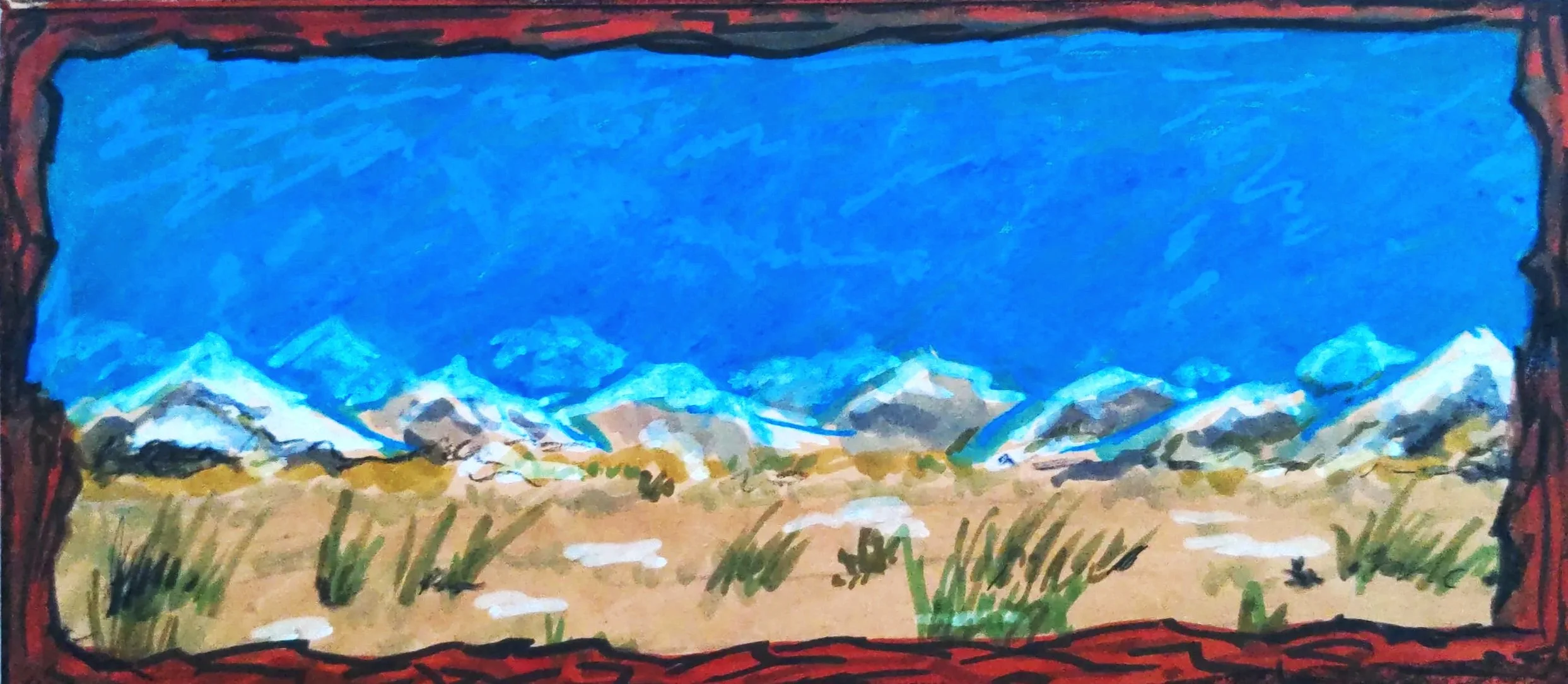
Tengrism was the traditional spiritual belief system of the nomadic peoples of Central Asia. From wiki:
Tengrism (also known as Tengriism, Tengerism, or Tengrianism) is a belief system originating in the Eurasian steppes, based on shamanism and animism, and commonly centered on the titular sky god Tengri. According to some scholars, adherents of Tengrism view the purpose of life as living in harmony with the universe.[1]
It was the prevailing religion of the Göktürk, Hun, Xianbei, Bulgar, Xiongnu, Yeniseian, and Mongolic peoples, as well as the state religion of several medieval states such as the First Turkic Khaganate, the Western Turkic Khaganate, the Eastern Turkic Khaganate, Old Great Bulgaria, the First Bulgarian Empire, Volga Bulgaria, Khazaria, and the Mongol Empire. In the Irk Bitig, a ninth-century manuscript on divination, Tengri is mentioned as Türük Tängrisi (God of Turks).
It is believed to also, broadly, to have been the belief system of the pre-Christian Hungarian people.
In modern Turkish the word for a God (any God) is Tanri (pronounced Tan-ruh)
And though modern Bulgarian uses the Slavic forms for God (bog Бог) and Sky (nebe небе), there is a Turkic-Bulgarian nativist/revivalist movement called Tangra Warriors Movement Движение "Воини на Тангра" which, as you can guess, also has nationalist anti-western associations.
The Mongolian word for sky is тэнгэр (transliterated as tenger).
In the context of traditional Mongolian spirituality and Tengrism, tenger also refers to the supreme deity, the Eternal Blue Sky (Mönkh Khökh Tenger), personified as the Sky Father.
While modern usage distinguishes tenger (sky/nature) from burkhan (God in a religious/Buddhist sense), the terms were historically synonymous for the divine force governing the universe.

An example of the Bulgarian Tangra Warriors Movement.
Source including more photos.
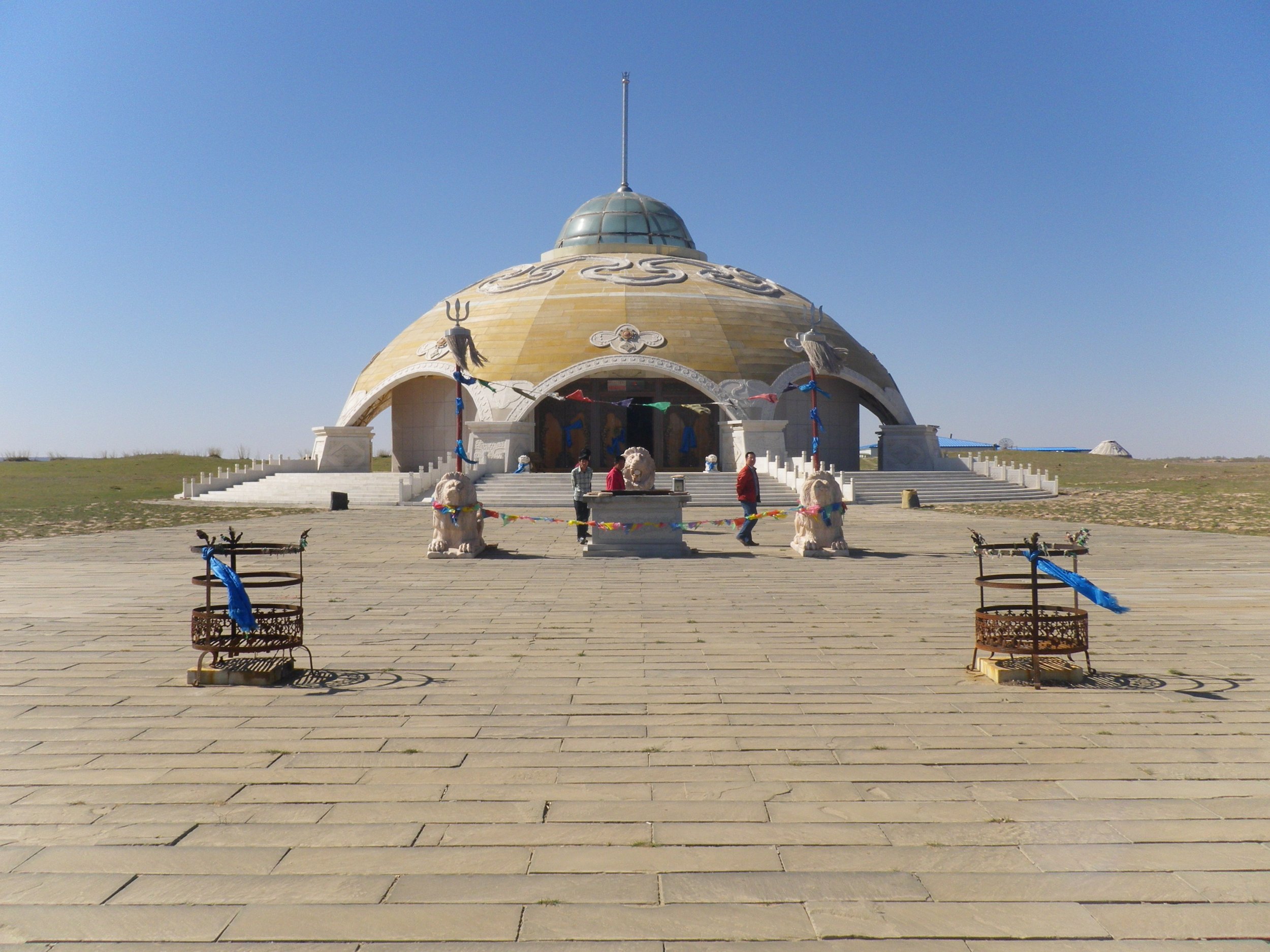
This is also interesting to look at, from wiki. A side view of The Temple Of The White Sulde Of Genghis Khan in Uxin, Inner Mongolia, China. Note that this blog does not endorse the behaviours of Genghis Khan nor the foreign policy of the empire he founded nor its medieval successor states. I suppose I should I give the same qualifier about the Ancient Bulgar Confederacy too and all other nomadic raider peoples lest I be considered racist.

The Mongols have a notorious reputation but it should be noted that this belief system shouldn’t be considered as one which espouses bloodthirsy world conquest.
From the wikipedia entry of the Irk Bitig (The Book of Omens/Divination), a 9th century manuscript found in a Northwestern Chinese Cave in 1907 and which is the only known complete manuscript written in Old Turkic:
The Sky God Tengri is featured in some of the omens (nos. 12, 15, 17, 38, 41, 47, 54, 60), and he is normally shown to be benign, for instance rescuing lost or exhausted animals (nos. 15 and 17). Also featured is the god of the road, who bestows his favour on travellers (no. 2), and mends old things and brings order to the country (no. 48).[12]
Odin AKA The Wandering God could also be considered a God of the road couldn’t he? Even though he isn’t associated specifically with roads. Just saying…
Why Am I bringing this up?
European belief traditions, and others, also place the supreme being as the God of the Sky or the Sky father (?Dio/Dieu-Pater becomes Jupiter).
Settled societies have God housed in a structure that points up to the sky. (God’s House). but for those who were on the move, never settled, they had simply the sky as the direct representation of God without a built-structure as the holy go-between. Of course they still had shamans and the like, their priests, who would use props and fire and the such.
For those of us who seem to live lives today that are also unsettled, whether we are always on the move or don’t have an established church or religious congregation we feel at home in, the skyfather is always there for us in the sky.
If the built world or modern civilization is feeling overburdensome or difficult, or you are in some other kind of dificult situation, look up once in awhile.
Interestingly, the Pan-Slavic word for God, Bog (eg: in Polish it’s Bóg pronounced Boug) has been proposed by a commenter on Quora as being the way the English got the word God, as they read Bog backwards, along with many other words the English and Germans got from Slavic (what are they, dyslexic or something?). That theory needs to be hashed out more. (Brave Ai disputes it, proposing instead that it from Sanskrit via proto-German to mean either “The Invoked One” or “The Libated One” , libate meaning to pour out a liquid in sacrifice honour of a diety).
But from the same Quora thread:
The Slavic root for ‘bogu’ goes back to the Proto Indo-European ‘bheh2g- which means ‘to divide, distribute, allot.’ With cognates to Sanskrit ‘bhaga’ meaning ‘happiness, welfare, prosperity’
The Slavic ‘bogu’ meaning ‘god’ appears to be semantic borrowing from the Scythian languages. Zoroastrianism, the new religion of the Iranians demonized the inherited dieties as in Sanskrit ‘deva’ = ‘god’, and Latin ‘deus’ = god. In Avestan ‘daeuua’ took on the meaning ‘demon’. During the time of Iranian contacts with the Slavs, the latter replaced the inherited Proto-Indo-European ‘deiwa’ with the Old Persian ‘baga’ with its meaning evolving from ‘wealth > ‘wealth provider’ > “god’ In Proto Slavic it became ‘bogu’ for ‘god’
There are other extensions to this Slavic word, but semantically closer to the concepts of ‘wealth’ and ‘prosperity’. One such derivative word is ‘bogaty’ which means ‘rich’ or ‘wealthy’.
and the next comment along:
Although it is found as the first element of some compound words such as Богдан (Bogdan, a given name), this is actually an independent word that means God. In Russian, бог (bog, “God”). All of the Slavic languages have it (with some slight spelling and pronunciation differences).
It comes from Proto-Slavic bogъ (bogŭ). Originally, bogъ meant “earthly wealth,” “well-being,” “fortune.” Later, the meaning shifted to “dispenser of fortune,” and from there it finally came to mean “god.”
It is uncertain how this word came to be in Proto-Slavic. One theory says it was borrowed from either Old Persian or Avestan. Old Persian, for example, had baga (“god”), ultimately from Proto-Indo-European *bʰeh₂g- (“to distribute, divide”).
Another theory is that it is from Ancient Greek ἔφαγον (éphagon, “to devour”), with an earlier meaning of “I received a share.” Ἔφαγον also derives from the Proto-Indo-European *bʰeh₂g- (“to distribute, divide”).