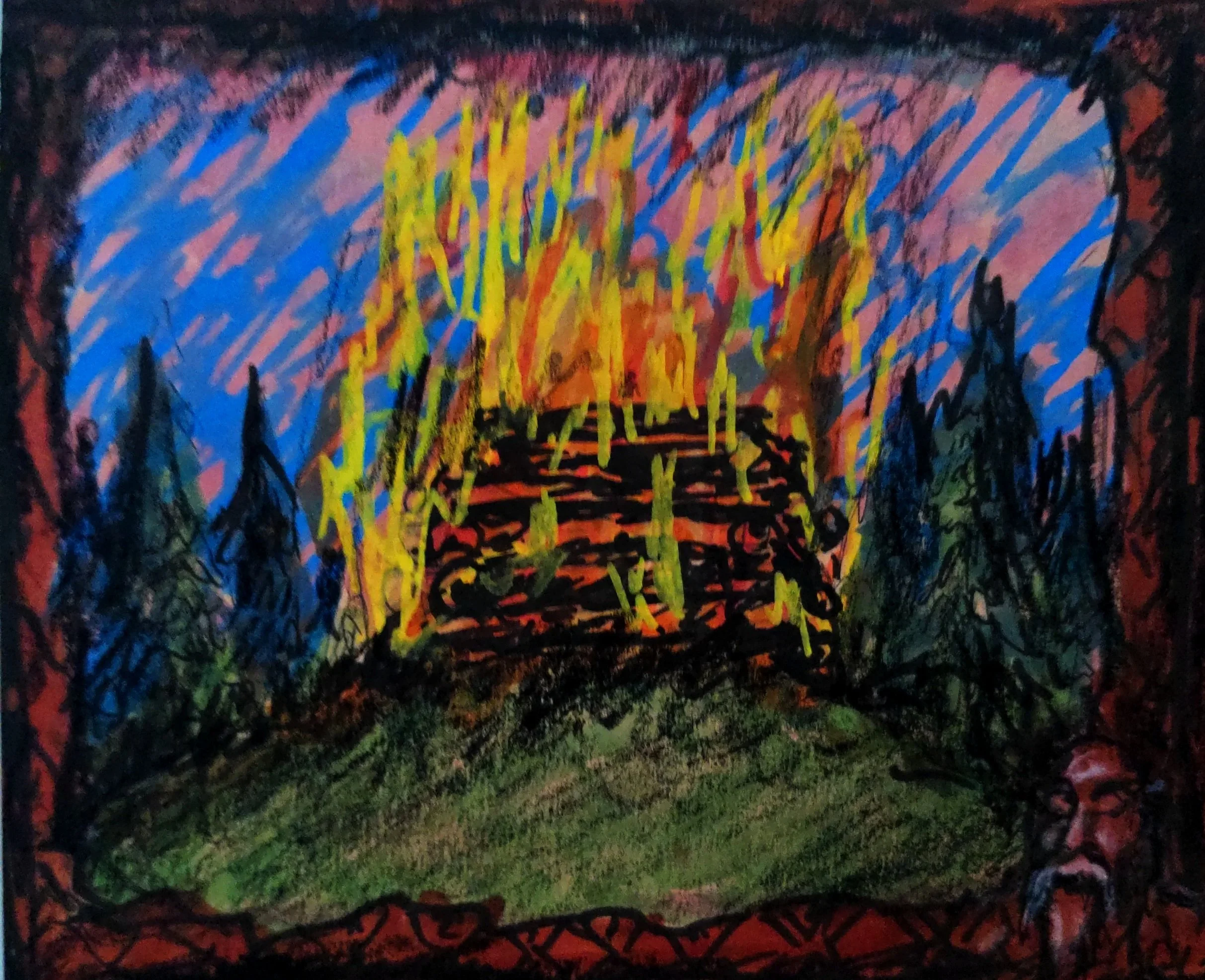
Rodnovery is the name given towards the practice of the Slavic Native (Pre-Christian/Abrahamic) Faith.
Practised throughout the Slavic world, it is an expression of the pre-historic Slavic religion. The contemporary form is, from what I can gather, an amalgamation of surviving folk customs, as well as elements of rediscovered history found through archeaology, studying old texts, comparing different Slavic cultures and adapting all these to some limited modern conventions for practicality’s sake. (like a beer bottle as a sacrificial offering, observers wearing modern jackets while the priests wear ornamental garbs etc).
Before talking about the belief system, maybe we should discuss the origin of the Slavs; The proto-Slavs.
Origin Of The Slavs:
The Slavic culture is believed to have begun around first or second millennium before Christ, but doesn’t really appear consistently in the established historical record until the late 1st millennium AD. The defining moments include, in no particular order: The first Siege of Constantinople in 628, Samo’s Kingdom and Carantania, The Great Moravian Kingdom, Byzantine monks Cyril and Methodius creating the Old-Church Slavonic (Glagolithic) script, the First Bulgarian State, the conversion of the Kievan Rus and the Baptism of Poland. There are also the recordings of Byzantine historians like Precopius of South Slavic Barbarians on the fringes of their empire.
In fact, it’s worth looking at what Procopius said. I’ve kindly asked Brave Ai to please give an account of:
The Slavs as mentioned in Procopius, according to Brave Ai:
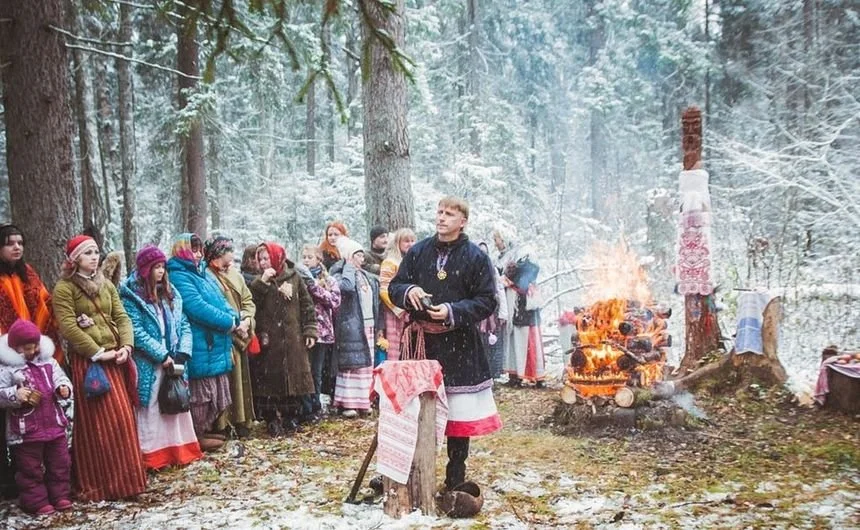
Rodnovery in action in Russia. The wiki link here is the source for this and all the further images in this article unless otherwise indicated. Naturally I did the drawing at the top of the page.
The Sclaveni and Antes were two distinct but closely related early Slavic groups first extensively documented by the 6th-century Byzantine historian Procopius in his works De Bellis and History of the Wars. Procopius described them as living north of the Ister (Danube) River in a state of primitive democracy without a single ruler, where decisions were made collectively in assemblies known as věče.
Key characteristics of these peoples according to Procopius include:
Physical Appearance: They were described as exceptionally tall and strong, with skin that was not very white and hair that was neither blond nor black but reddish.
Social Structure: They lived in scattered, isolated huts and were organized into tribes without social stratification, though a military aristocracy began to emerge by the sixth century.
Warfare: They were skilled in guerrilla tactics, ambushes, and archery, often using poisoned arrows. They typically fought without metal armor, relying on spears, light shields, and bows, though some served as mounted mercenaries for the Byzantine Empire.
Religion: They practiced polytheism, worshipping a supreme deity identified as the creator of lightning (later associated with Perun) and various nature and water deities, to whom they sacrificed cattle and other animals.
Origins: Procopius noted that the Sclaveni and Antes shared the same language and were previously known by the common name Sporoi, implying a shared ancestral root distinct from the Veneti mentioned by other historians like Jordanes.
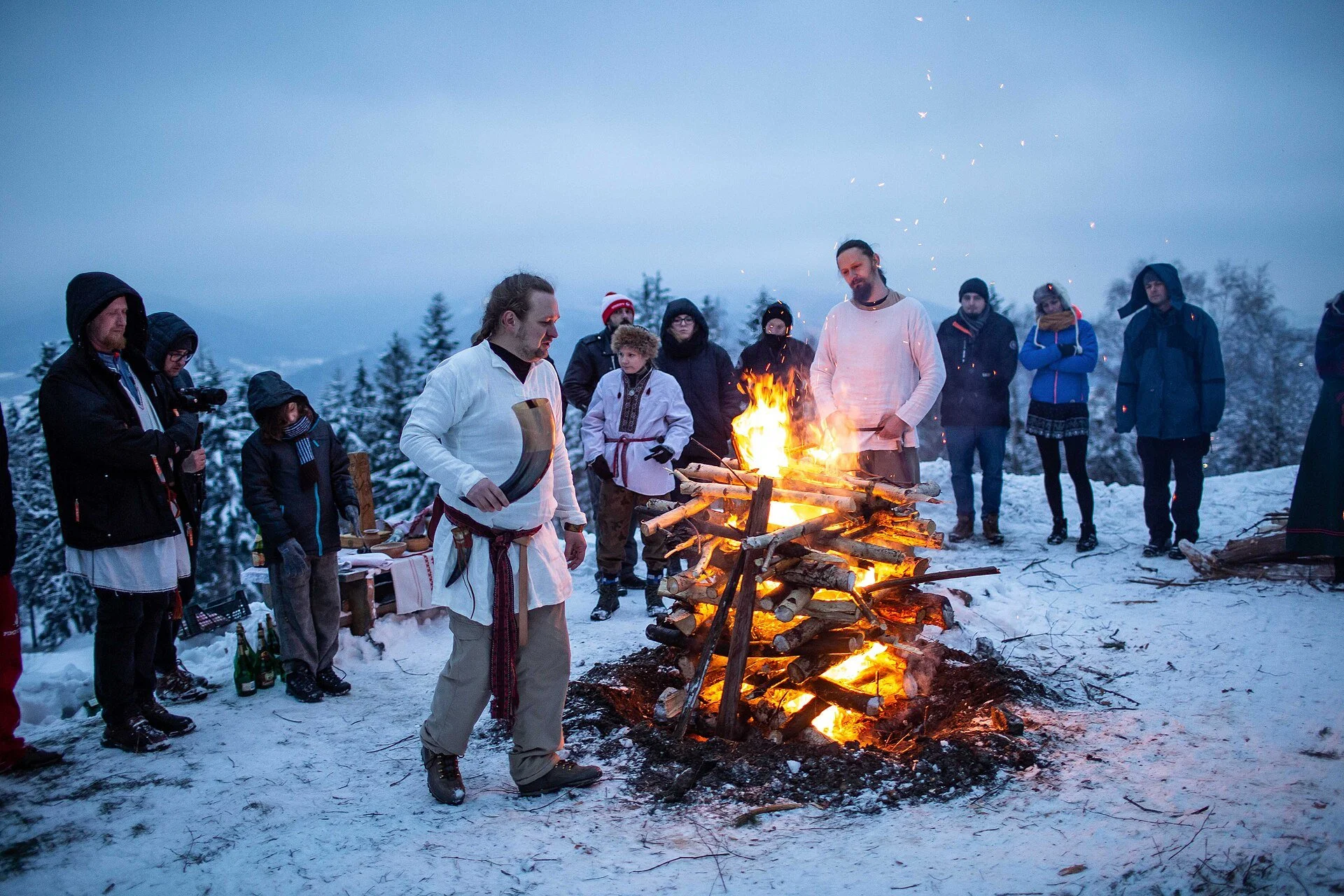
Rodnovers in Poland
The Slavs are harder to pin down in the writings of the earlier Western-Roman (latin) writers who were commenting on the barbarian tribes beyond the Danubian frontier. Tacitus explicitly mentions the Venedi and historians seem to concur that these were likely a proto-Slavic group. But Tacitus talks more broadly and explicitly about the Germanic tribes. Of those, the most famous Barbarians in the classic telling of Western-European history, are, the Huns and the Goths. Neither were Slavic speakers and there is a sufficient record of their language to attest to that. (there is even a Gothic bible). And this is remarkable because the Huns pushed pretty much everyone else into western Europe. Wherever the Slavs were for these centuries, we were good at hiding or laying low. Perhaps its a major racial trait.
Its worth looking at what Jordanes said.
The Slavs as mentioned in Jordanes, according to Brave Ai:
The Gothic historian Jordanes provided the earliest known detailed account of the Slavs in his 551 work, the Getica, describing them as a populous group originating from the region between the Vistula and Dniester rivers. He identified three main branches: the Veneti (ancestors or broader group), the Sclaveni (early South Slavs), and the Antes (early East Slavs).
Key characteristics from Jordanes' description include:
Geography: Their territory extended from the Danube northward to the Vistula, with the Sclaveni inhabiting swampy and forested areas.
Physical Appearance: He described them as tall and very strong, with ruddy faces and hair that was neither very blond nor black.
Lifestyle: They lived a hard life in forests and swamps, which Jordanes metaphorically called their "cities," and were noted for their frequent warfare against the Byzantine Empire.
Ethnogenesis: Jordanes claimed these groups derived from one stock, though later historians debate whether the Veneti were a distinct earlier tribe or synonymous with the Slavs themselves.
The origins of the name are interesting.
Origin of the word Slav, According to Brave Ai:
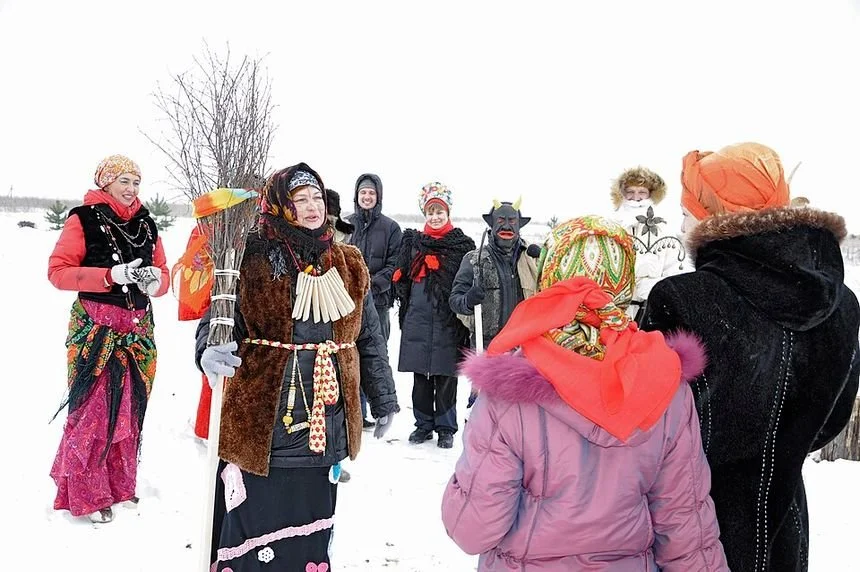
These are a sub-group of Rodnovers known as Anastasians, found in Russia.
The word Slav originates from the Proto-Slavic autonym Slověninъ, which early medieval Byzantine Greek and Latin sources rendered as Sklabos and Sclavus.
Etymological Theories
Speech Community: The most widely accepted linguistic theory connects the name to the Proto-Slavic root slovo ("word" or "speech"), implying the Slavs were "the people who speak" (i.e., those who are intelligible), in contrast to "mute" foreigners.
Glory/Fame: The name is also linked to the root slava ("glory" or "fame"), derived from the Proto-Indo-European root *ḱlew- ("to hear"). This root appears in many traditional Slavic personal names like Miroslav and Jaroslav.
Toponymic/Hydronymic: Some scholars, such as Max Vasmer, argue the name derives from a place or river name (e.g., Slovutych), as the suffix -ěninъ typically denotes origin from a location.
Relationship with "Slave"
The English word slave is etymologically derived from Slav, not the other way around. During the early Middle Ages, many Slavic peoples were captured and sold into slavery by Germanic and Arab conquerors. Consequently, the Medieval Latin term sclavus (meaning "Slav") gradually acquired the secondary meaning of "servile person" or "slave," which then spread through European languages.
If one picks up on how often the “sl” or “sla” or “slav” sound appears in slavic speech, it could also simply be that the formal name “Slavs” grew out of a perceived sound that kept popping up and eventually that became what neighbouring language groups came to label this group of people in question. (abit like how the words “jazz” and “hiphop” began). Or we Slavs had named that ourselves and those early personal names indicated a tribal marker with the suffix -slav.
When more than one plausible theory exists, I usually like to assume a combination of all of them is likely the explanation.
Polesie: The Homeland of The Proto-Slavs
There is a strong consensus on the geographic origin of the proto-slavic language being roughly around the border between Belarus and Ukraine, stretching from Eastern Poland to Russia. It’s an area that historians have come to call Polesie. One could also say it’s the area to the north of the train line from Krakow to Kiev, which I travelled across once. It’s even been specifically claimed to be the Pripet Marshes of Southern Belarus. This has been argued as the hiding spot that kept them free from Hunnic assault, the marshes being too hard for the horsebacked Huns to traverse, especially considering they were raiders. Added to that the thick forests being too difficult for composite bows to penetrate and the lack of civilizational wealth making them not worth the effort. When clear fields and roads lead to Rome, by that point an exhausted and decadent entity full of brighter and shinier loot but enfeebled inhabitants, why not raid the easy pickings instead?
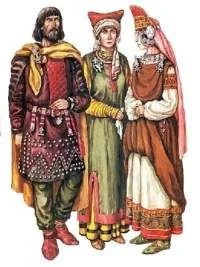
Image taken from the site rodnovery.ru
Some further argue that the contemporary projection of a “Hunnic Empire” is exaggerated. They were a loose confedertion and Attila was nothing more than a glorified bandit and pimp, too lazy for proper empire-building in his own right, and I would say there’s some truth to this. Head here if you want to read an old autistic debate on the matter. It could be that there was an inherent memory from the Slavs earlier experiences with horse-peoples to go into land where horses found it hard to maneouver. At some point the Slavs would master the horse but this would be centuries later.
One conclusion I will draw from this is that there tends to be an innate behaviour across all Slavic people, especially noticeable in comparison to the more industrious up-and-go westerner types. Slavs tend to be laid back and chilled. You could say lazy. But I would counter that there’s an intelligence in that. If one observes the historical experience, keeping a low profile and out of stampedes is a great survival strategy and also a way to pick up whatever gets left behind once the hysteria is over. Let someone else expire themselves doing all the hard work and reap the benefits.
The Slavic Expansion
The Great migration period into the rotting carcass of the Western Roman Empire created vacancies in the East of Europe. Thus from their point of origin, the Slavs fanned out in three directions: West, east and south. There is even a folk tale built around it: that of Czech, Lech and Rus (Lech being the Polish contingent, and several languages across Eastern Europe and the Middle East, such as Lithuanian, Hungarian, Ottoman Turkish and traditional Persian, refer to Poland on the base word of “Lech” instead of “Pol”). There’s a lot of versions out there but here’s one:
The legend goes that the Slavic tribe was multiplying so quickly that the three brothers in charge, Lech, Czech and Rus worried about not having enough food to feed everyone, so they called a meeting and decided to move as a tribe, with armed men at the front and back and the women and children on carts to ease the journey. Despite difficulties of crossing rivers and thick forests, the people had faith in their leaders. When they finally reached the plains interspersed with rivers glittering in the sun, Rus said his people were tired and they would stay on the plains (Russia). The brothers agreed to meet again and Lech and Czech carried on towards the sun until they reached the mountains.
Czech saw the beauty of the setting sun on the mountains and told his brother he would stay there (Slovakia and Czech Republic) but that they would all meet again. Lech continued with his tribe for many days until he saw a place with rivers full of fish, forests and fertile soil. Although he was enamoured with the place, he felt he needed a sign from the gods. Then he heard shouts as a huge, majestic eagle with radiant white feathers landed in his nest on a huge oak tree. Everyone was stunned as they saw the great bird against the red setting sun. It was a sign from the gods. The settlement of Lech became known as Gniezno (from gniazdo, nest) and was given the symbol of a white eagle on a red background. Calling themselves the Polonians, or people of the field this became the Polish nation.
The folk tale doesnt line up with reality exactly, as both the Poles and Czechs are West-Slavs, while the South-Slavs (Yugoslavs, modern Bulgarians) don’t feature in that folk-tale. And THAT probably indicates either that the South group split off first, or that the South group was so distant from the West and East groups that they were detached from the source of whoever spun that yarn… Or the story is true and someone accidentally(?) subbed out the South representative for another Western representative at some point? (It needs a whole article of its own, including this very obscure prelude of the common father being Prince Pan of Pannonia. Other versions have the brother Hunting and Lech chasing a lost arrow, or the brother Rus being excluded altogether in many earlier forms. Read here for now if you want to go further). The linguistic historians have determined that because the Slavic languages and the Baltic languages (Latvian, Lithuanian) share a genetive case, they both must have a common root. And furthermore, because the Slavic languages adopted Iranian loan words that don’t feature in the Baltic languages, the Baltics must have split off before the Slavs came into contact with the Sarmatians, Scythians and the like. At least thats the theory im pondernig as I write this. WHo split off who when can become a chicken-and-egg argument without sufficient archaeological evidence.
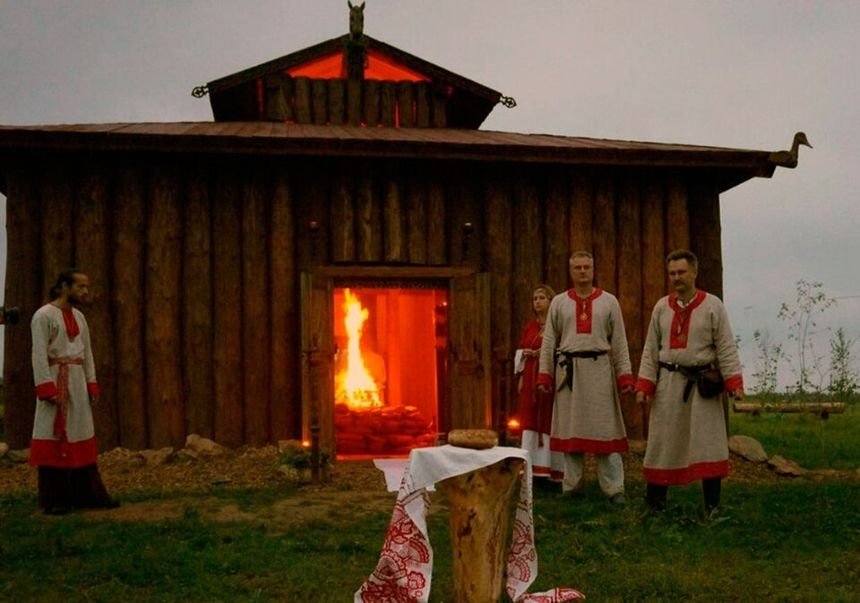
A ceremony in the temple of the Fire of Svarozhich of the Union of Slavic Communities, Kaluga Oblast, Russia. The USC (Союз Славянских Общин in Russian) in 2014 became the first Rodnover organisation to be officially recognised by the Russian Government,
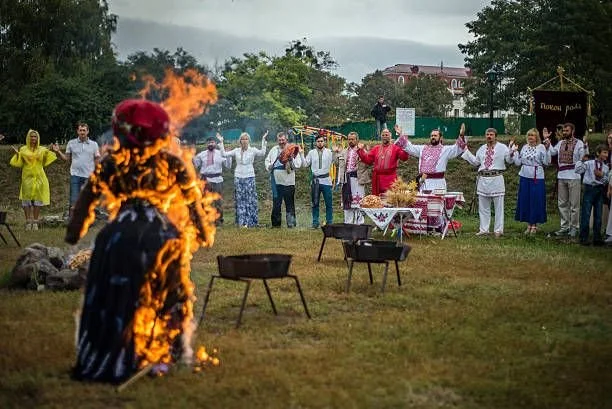
Rodnovers in Ukraine celebrating the holiday of Svetovid. Source Getty Images.
Brief overview of the Rodnover belief system:
Rodnovery as a system of spiritual worship. emphasises rituals taking place in the forest. And Europe was once covered in forest. What its really about is, through ritual, serving as a reminder that all Slavic peoples stemmed from one group in Eastern Europe. Its an ethnic baseline. Considering how widespread the Slavic tongues have become, it’s important.
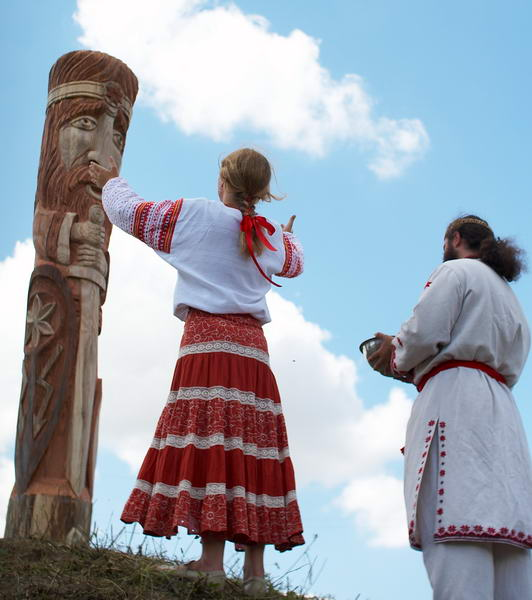
Ukrainian Rodnovers worshipping Perun
Everyone likes to point back to a homeland, an origin point. For some, it’s a city: London, Rome, Mecca. The Slavs can’t really agree on a single city. Most of the important Slavic cities are around 500-1000 years old. The wars are constant, the religious authorities have never been agreed upon. But there is evidently alot we have in common and there is evidently some kind of mythical homeland over there in the East.
I’ll paraphrase the basics via Brave Ai with a little bit of copypasta:
The etymology of the word is a calque Russian роднове́р (rodnovér), constructed from rod (tribe/origin) and vera (faith).
In Polish it’s Rodzimowierstwo, In Czech it’s Rodnověří.
Quoting Brave Ai:
Early Usage: The earliest known usage was by Ukrainian emigre Lev Sylenko, who published a mimeographed journal titled Ridna Vira ("Native Faith") in Canada in 1964.
Popularization: The portmanteau Ridnovir was popularized by Volodymyr Shaian in Ukraine by at least 1995.
There was a pantheon of Gods, of which the major ones are:
Perun - The Chief God and God of Thunder, Lightning, Law and War.
Veles - God of The Underworld, Cattle Wealth and chaos.
Svarog - God of Sky and Fire, associated with the honourable work of Smiths.
Dhazbog - God of the Sun, Giver of Wealth (and perhaps the origin of the pan-slavic word for the Christian God: Bog).
Mokosh - The Godess of Fate, Fertility and Women’s Crafts.
This is a topic that I can go on and on about but I might have to leave it there for now as the above is already a massive chunk to digest. The mysteries out there are neverending.