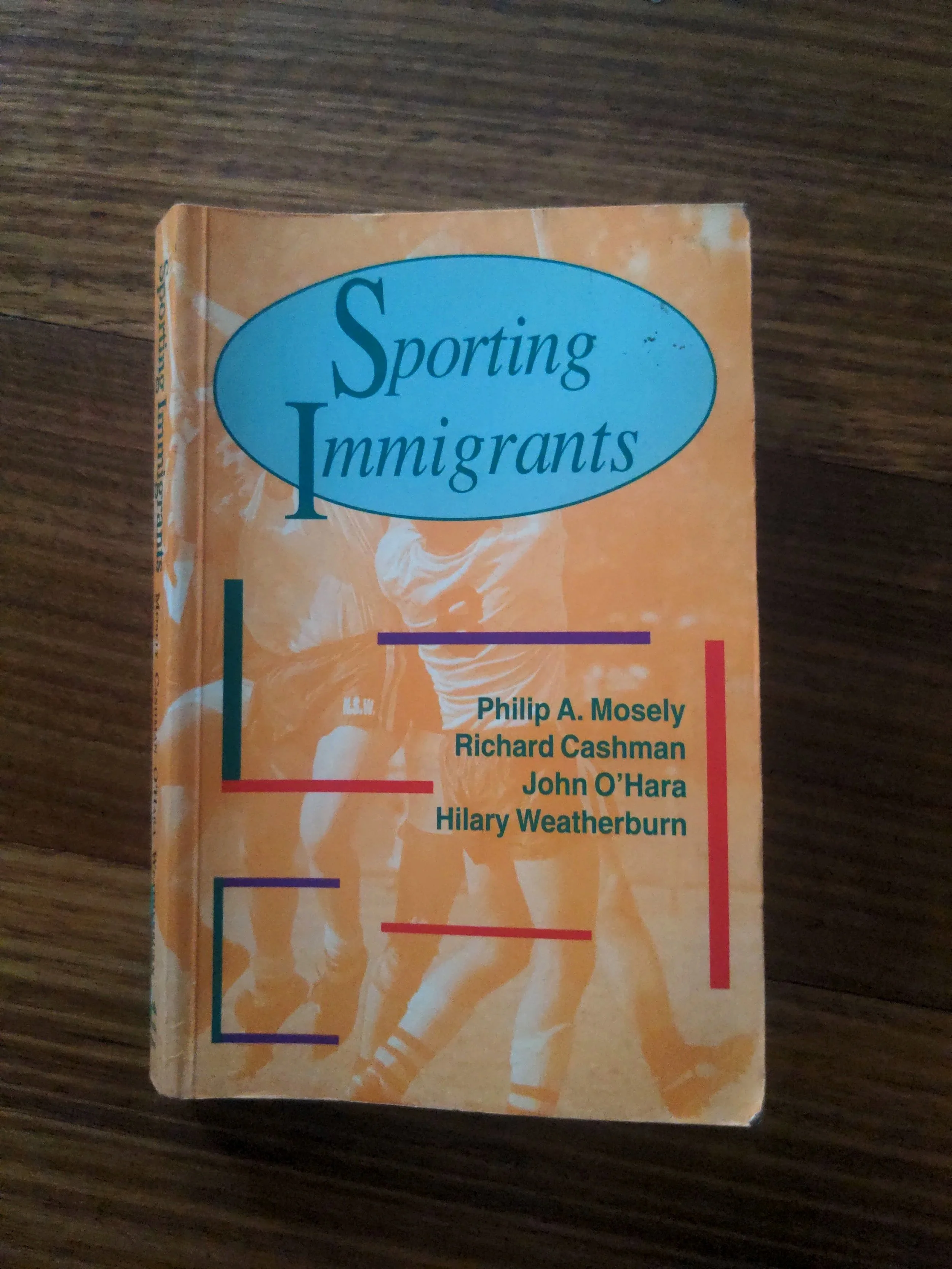
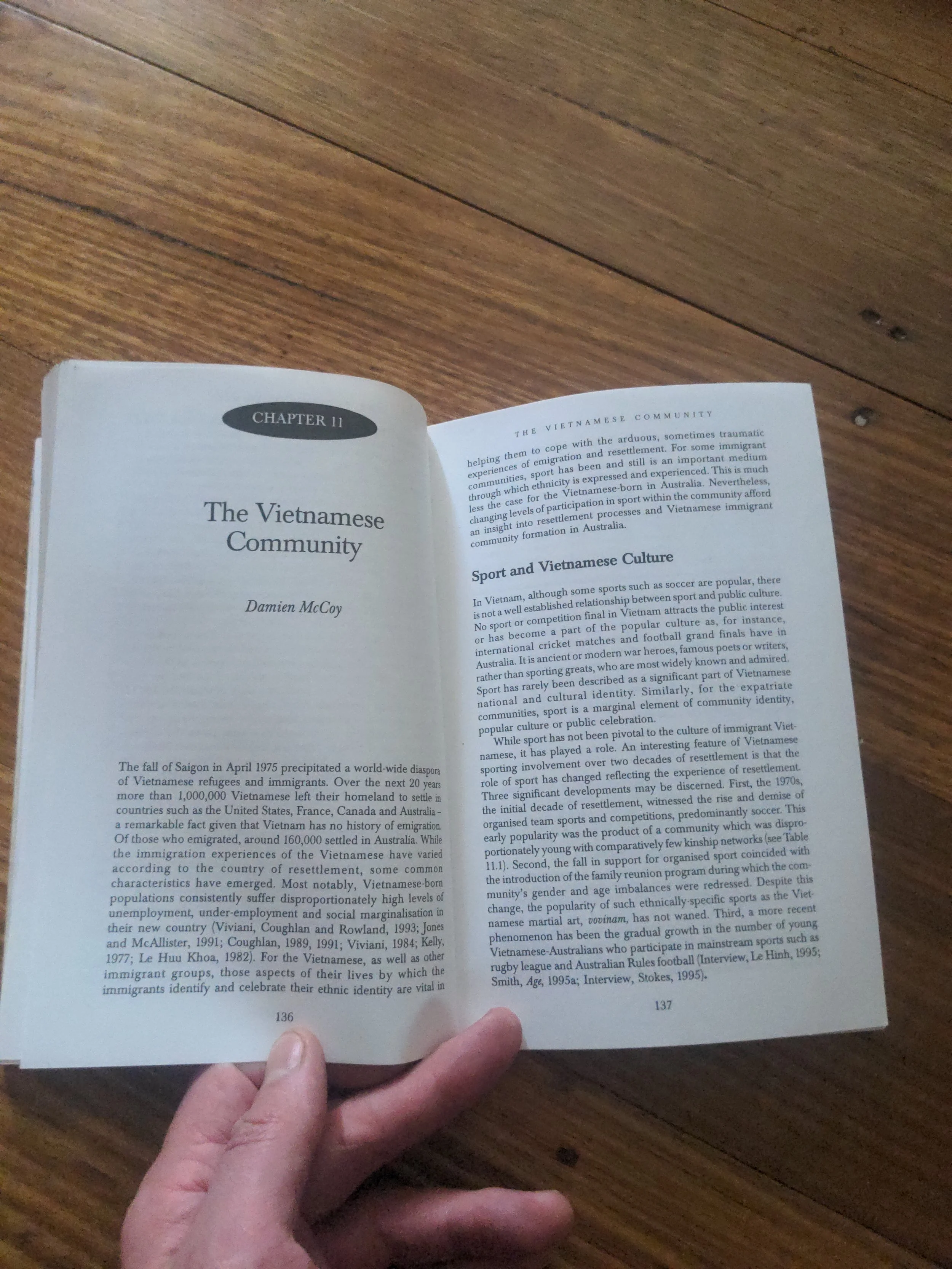
Book Review: Sporting Immigrants
This was an interesting book I’ve just read.
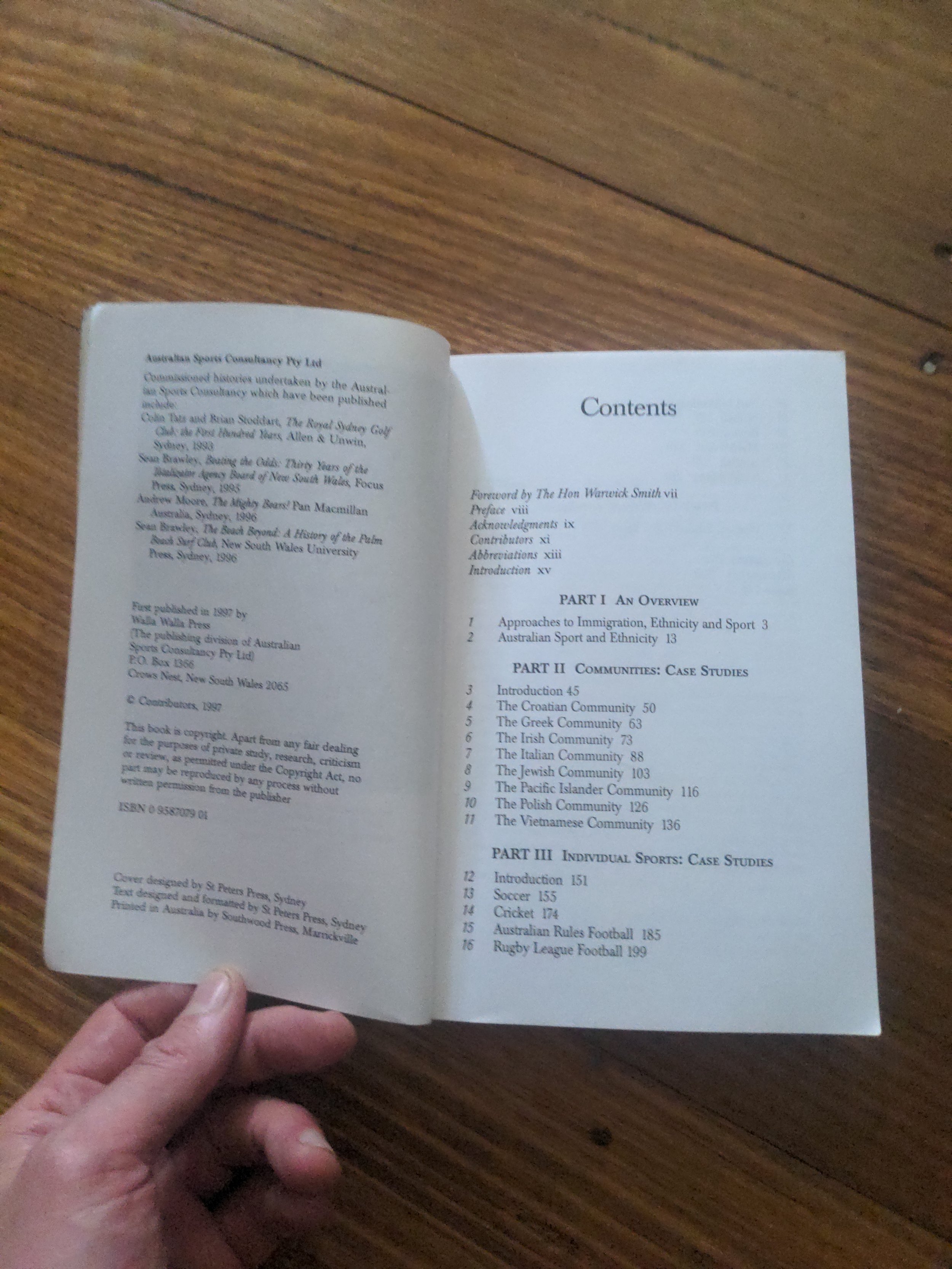
It was published in 1997, is about 300 pages, and looks at a handful of the most significant migrant ethnicities of Australia at that time and the sports they played.
Groups featured:
-Croatians
-Greeks
-Irish
-Italians
-Jews
-Pacific Islanders
-Poles
-Vietnamese.
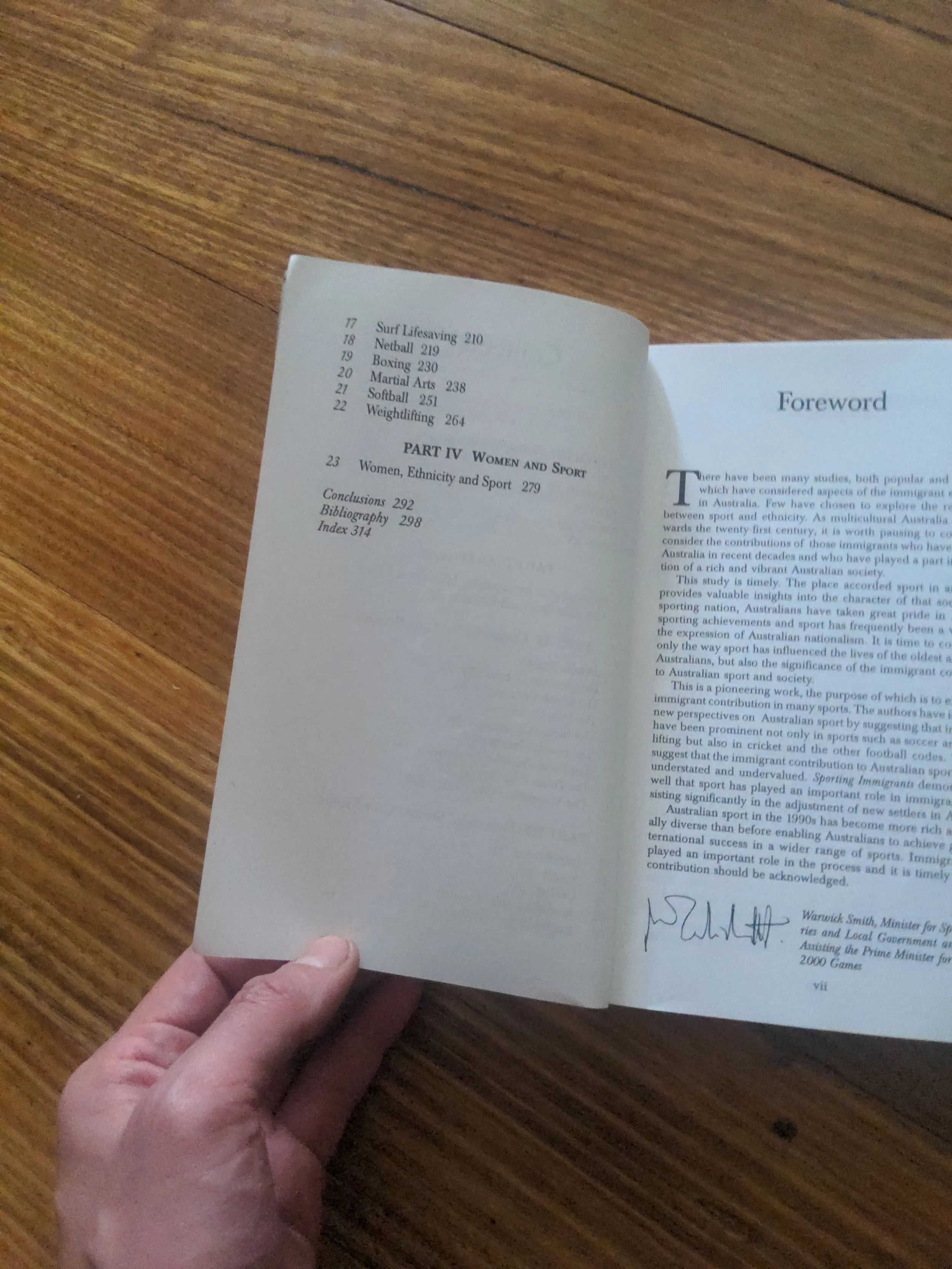
The Sports included are:
-Soccer
-Cricket
-Australian Rules Football
-Rugby League
-Surf Lifesaving
-Netball
-Boxing
-Martial Arts
-Softball
-Weightlifting
There are numerous individuals mentioned and a few other ethnicities within the major chapters.
Some names and their backgrounds will surprise you, even if you are pretty familiar with Australian sporting lore. Eg: 1984 LA Olympic Weightlifting Gold Medallist for Australia Dean Lukin, a famous win at the time (the moment was replayed for years and will probably have been seen by everyone who watched Aussie TV in the 1980s and 90s, search for it yourself if interested), who is mentioned as actually being of Yugoslav descent ( which the book does sportingly and ironically point out was probably assisted by the Soviet-bloc’s boycotting of that edition of the Summer Olympics). The book also details not just athletes but also clubs, managers and, what we would now call, “influencers” such as the Coffa brothers (of Sicilian background, who were highly influential in the development of Australian weightlifting but were also prominent in non-sporting public life. Sam Coffa was a councillor in the City of Hawthorn in the 1970s and 1980s, serving twice as Mayor) and of course Australia’s famous publicly-funded ethnic Radio/TV broadcaster SBS (AKA Soccer-Bloody-Soccer, or as it was also known in school owing to it’s broadcasting of racy foreign films: Sex-Boobs-Soccer).
Women are featured prominently as is the cultural debates around their participation within sport within certain ethnic groups. Though Muslims/Middle-Eastern groups were not a major presence in the Australia of this era they sprout up occasionally across all chapters as individuals and with regards to female participation they are discussed. Gays and Trannies are thankfully not mentioned at all. In the 1990s we didn’t actually have to know about them all the damn fucking time. It was a golden age.
Aborigines are discussed and the odd Latino individual pops up too. Probably Sub-Saharan Africans are the only major group not featured (although White South Africans get some mention) and many Asian nationalities are not mentioned, but this book can be seen as a major marker for how much Australian society has changed in its demographic makeup in the 30 years since it was published. There were simply not as many Asians or Africans (or Latinos) around in Australian society back then. Not by a long way.
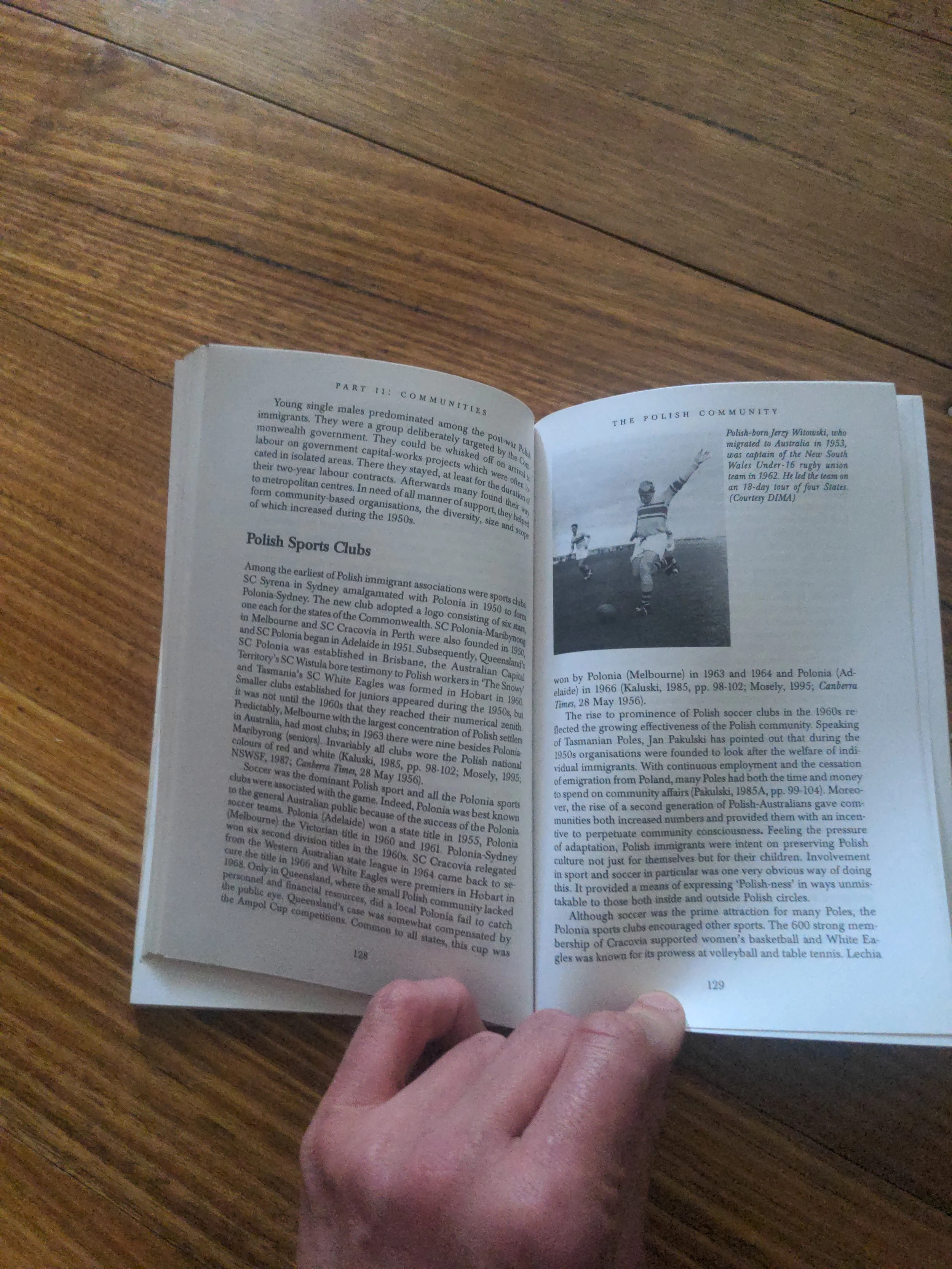
Certain hostilities that are now pretty trivial compared to the current debates of the 2020s were much more heated at the time of this book’s publication (though that is not to say they won’t re-heat especially in the current global climate). EG: The various Yugoslav and Greek factions fighting against each other amidst the backdrop of political strife in their ancestral lands. The Yugoslav ones I knew well about, being pretty contemporary to my time growing up as a kid in 1990s Melbourne. The Greek hostilities were at their height a generation previously, in the 1960s-70s, and so I knew a lot less about that. But it certainly explains a lot about Melbourne-Greek temperament now and why they always were the way they were. And then there’s the Irish. They held outsider status in the 19th and early 20th century, and the book documents some pretty insane hostility between them and the mainstream establishment, which at the time was defined as Anglo-Protestants (and NOT Irish Catholics). It’s strange now seeing as the white Australian mainstream has for so long been referred to as “Anglo-Celtic”. But not only that, The Irish of Colonial-Australian heritage also came up against less-hostile but still-awkward differences with the post-war Irish who came to Australia to seek a better life, in terms of their club and community life, lifestyle and the games they wanted to play. This book excels at paying attention to those details. It comes up also with the Polish chapter. Pre WW2, about 80% of the roughly 8000-strong Polish community in Australia were Jewish. The immediate post-ww2 wave that subsequently came along swamped the pre-existing numbers and were overwhelmingly Catholic rural-peasants, thus completely changing the dominant religious orientation of the ethnic Polish-Australian community, rising to about 50,000 according to the mid-20th century censuses. The fact that they were rural peasantry meant that their preferred jobs tended to be nation-building projects (like the Snowy Dam) and factory-work. Then from the end of the 1950s there was a hiatus of about 20 years before the 1980s wave came along (which is my parental line into Australia), which though Catholic tended to be more urban and educated. (Don’t be offended, that doesn’t necessarily mean smarter or knowing any better). What that often meant was having degrees and certifications that were completely untransferable to Australian society, and having to suck it up and find more humble alternatives. I don’t know of any who became taxi drivers but if you’ve ever ridden in a cab driven by a Syrian Lawyer or Egyptian Brain Surgeon you’ll get the idea.
Seeing as I’ve done a fair bit of martial arts, soccer and snowsports in my life, I can say that the book gives good analysis to all of them, explaining the cultural currents which drove their popularity with certain groups of people as well as prominent individuals and clubs. But here’s the thing, the book is also, between the lines, I suspect trying to be a prophecy of a social future that ultimately took a different direction from the one imagined. I never knew about the Vietnamese fighting style of Vovinam and I never knew there was so much to know about it. Something for me to investigate further. But needless to say, of the 100-odd sports both major and niche I’ve ever come across, well I think you get my point…
Certain elements of social friction have never seemed to go away: British Isles vs Continental Europe, Western Europe vs Eastern Europe, Northern Europe vs Southern Europe, Aboriginal vs non-Aboriginal, Black vs White, Anglo vs non-Anglo, Asian vs non-Asian, Australia vs the US, Australia vs the UK, Crown vs Colonies, British Empire vs anti-Empire, Catholic vs Protestant, Christian vs Non-Christian, Democracy vs Communism, Rich vs Poor, City vs Country, Occupied vs Occupier, and so on (so pretty much nothing ever gets solved, in other words). But this book is good at not only investigating a particular groups sense of identity and difference, but the frictions and hostilities that can occur within those groups on regional/class/political/gender lines. I didn’t really find the books approach to any of these topics to be prejudiced any way, it does very well in taking a neutral and even-handed approach. Although some of it pretty aggravating to read, and in other sections a bit dull and arcane. Nevertheless, I found it very interesting and insightful overall and would recommend it to anyone who wants a better sense of the nuances of Australian ethnic dynamics. I found my copy in the op-shop so I assume it is available online as a secondhand copy or in the various used bookshelves around the country if you keep your eyes peeled.
What is my conclusion from this book?
Assimilation is never easy and never quite complete, and is not even always entirely desirable. You should generally have the freedom to associate and disassociate. Though, as I’ve always believed, you get to a certain point where you are just hair-splitting and need to accept some things as just being the way they are. But that also doesn’t assume you have to always go along with what your ethnic group or the mainstream want, as these are also constantly changing (You can also say the same thing about your class, religion or whatever other cultural banner you choose to adopt). Imo if something seems too stupid, weird or wrong to you then just don’t force yourself to go with it. And don’t be shy about calling things out that you don’t like. We all have our limits. That’s the spirit of this blog anyway. Of course in saying that we all have our common obligations to whatever we define is our core society. And if you don’t like it then you might have to relocate to somewhere that’s easier for you to live in. It might be back to the old country, somewhere else in the new country, or to an entirely different country.
Of course sometimes the change is done for you. The government dumps a whole bunch of new people on you and you realise your points of difference with the other existing groups weren’t so great afterall. Sometimes the economic circumstances change rapidly because of global shocks or deteriorating local conditions and you and other people might find themselves in different circumstances with new requirements of co-operation. These might mean co-operating more or fracturing. Who’s to say. But in those times, it might help to learn something about the people around you. And that’s why I found this book beneficial.