Book Review: Blood, Ink and Linseed Oil
Well I’m back at the shop for 2026. Nothing but my laptop, my mind and my two hands for company. And when there is no repair and I am fatigued by doomscrolling the net there is only two things left to do: draw those graphic cartoons I do or write articles. This bride-and-groom arrangement combines to form a blogpost, and the throttling energy of this blog last year was powered by that combination of boredom and restricted means.
I got pretty much all the summer tasks done that it was within my limited practical means to do:
- caught up with the friends and fam that I wanted to, or did my best to.
-I bought some cheap books from the op shops and online.
-i sunned myself in the driveway.
-I fixed some of the critical issues of my car, until I hit a wall of frustration and the belated summer heatwave took over my will to do anything.
-I did some local research for upcoming art projects and some surface prep for paintings. They are now gestating from the conceptual stage to be on a course of production that hopefully sees completion before the cold weather snaps in and renders the oil, bones and muscels stiff and unmoveable, sinking me back into winter hibernation mode.
-I got some reading done. The critical reading was the books I ordered online, which was about 3 or 4 titles, and they all arrived in time for me to consume them all by holiday’s end.
Every book I hungrily devoured, the last one I read is the subject of today’s review:
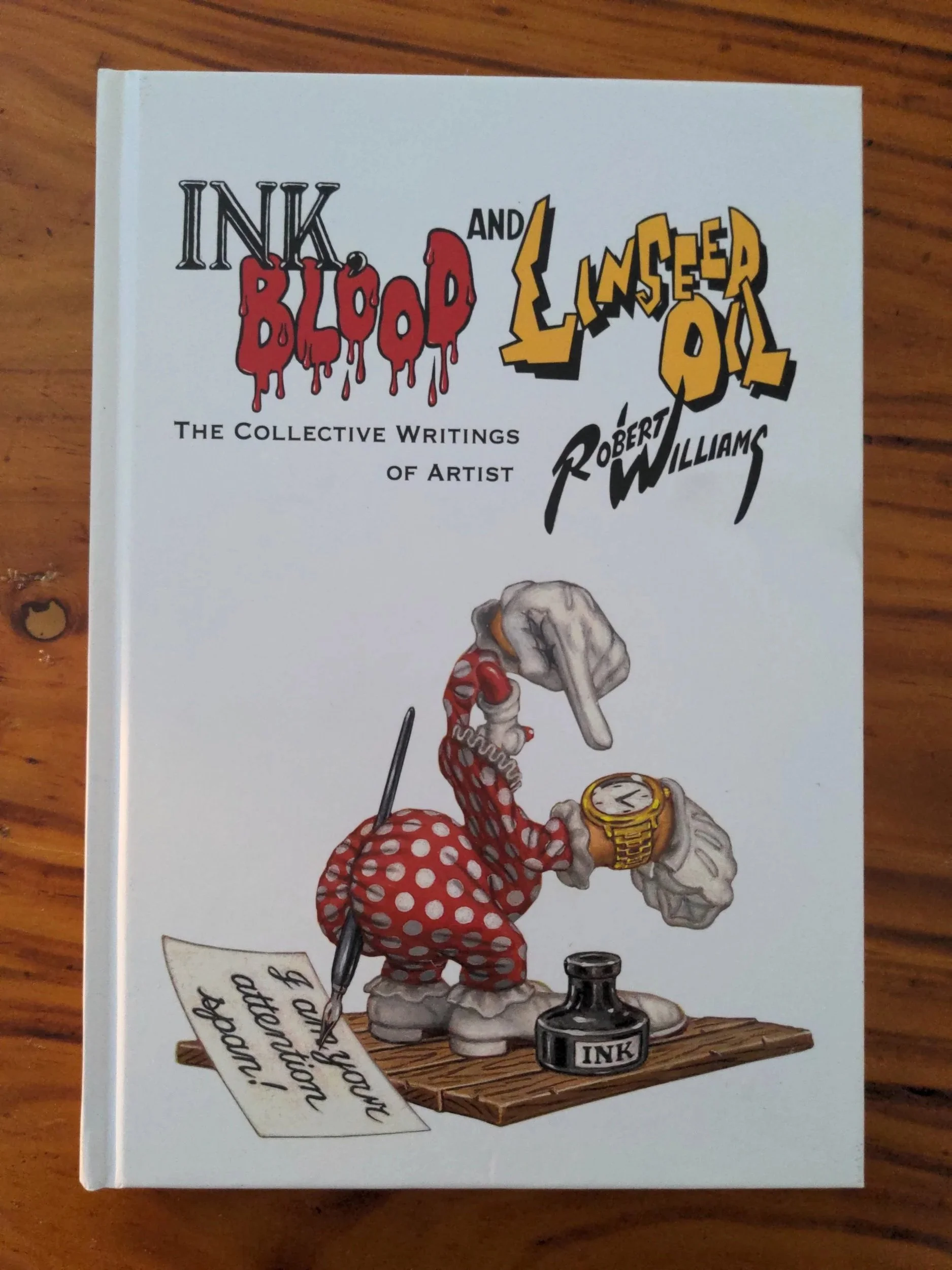
Blood, Ink and Linseed Oil: The Collective Writings Of Artist Robert WIlliams
Needless, to say, this is for the art afficionado.
Robert Williams is a Californian visual artist and the founder of the legendary art magazine, Juxtapoz.
This book, published in 2022, collates the various essays and columns he wrote for Juxtapoz from its founding in the early 1990s to about 2006, with a couple of manifestos, photos and a latter-day 3rd-party article to tie up the end.
Robert, who in his paintings signs his name as Robt, is someone who’s name I only really became directly familiar with over the last 2-3 years as someone who was properly significant. And yet I’ve been familiar with some of his work, either as painter or magazine editor, and thus been in the outer orbit of his influence, for much of my life. That’s the power of a good artist, marketer and visual communicator.
Robt Williams was born in 1943 and was peers with Robert Crumb, Ed ‘Big Daddy’ Roth and a bunch of American visual/graphic artists of his generation. This book compiles alot of the experiences of their era and I devoured its contents pretty hungrily. It only really affirmed that I owe this man a lot and that his artistic philosophy lines up with mine quite well.
Still alive at 82 going on 83, he is a champion of outsider art. And specifically, 2D artists who valued technical skills but shunned elitist pretensions. Meaning they were shut out of the fine-art gallery status quo. They didn’t want to do theory-dense anti-aesthetical post-modernism and they didn’t want to draw or paint the overly familiar tropes of western-art from the previous centuries (your pre-1960s wallpaper art, or anything that is boring via overfamiliarity).
They wanted 2D art that was representational, but exciting and fun. And Juxtapoz was founded to highlight artists who did just that. This includes your hot-rod art, underground comix, and those who dabble in thematic extremities whilst still adhering to techinical skill. Regardless of how open or broad your brief is, over time a unifying aesthetic does begin to solidify, so in California that tended to be hot-rods, pinart-nudity, smiling devils and surfing eyeballs, cartoon characters, Mexicana, polynesia, grafitti, horror/sci-fi movie tropes and the like.
The terms kustom-kulture, pop-surrealism or low-brow art are often used to describe the hodgepodge, but in one editorial Robt offers a few others thrown his way, including frozen rock’n’roll.
But the editorials also display an understanding of modern art and how it came to be what it was, even though its late-20th century products were scorned by the magazine. A recurring theme is that there is no bad art, there is just art that isn’t for you. I like that, it’s using modernism and post-modernism’s own arguments against itself.
You can’t escape geography as a big factor in opinion-forming here. Robt Williams is aware of it. Modern Art was based in Western Europe, especially Paris, but jumped over to New York when the Nazis come to power. The snobs of Californian galleries and the formal-art nexus were in service to the mindset of a North-Atlantic urban elite (in Melbourne it still is this way). But the world is wider than that.
Class is another marker. Hobos, skaters, vandals, petrolheads, backyard mechanics, tattoo artists, bikers are all mentioned, and more.
Robt wasn’t alone in the startup, and he is generous in praise to those who were around him as artistic peers or who contributed significantly to Juxtapoz (the defined roles seem a bit muddy, and I’m gonna assume no one was obsessively hung up on labels in the early years. No animosity pops out of the pages). Particularly among them was a magazine co-founder, who also seemed to provide the main investment funds and network infrastructure as well as being the editor till his death in 2006: Fausto Vitello. Fausto was himself a cultural entrepreneur, having founded Thrasher magazine and significantly contributed to the 2nd-wave of skateboarding culture that arose in the 70s and 80s.
This is all fairly culturally libertarian in the American vein, and oversees the tail-end of the active US west-coast counterculture born out of the 1960s, as well as the rise of the internet and digital technology, the arrival of Japanese, Latino and Pacific culture, 9/11 and the war on terror, and a couple of allusions to behavioural patterns in the Millennials that I think fairly solidly point to the madness and social ruin of the great aWOKEning.
I’m 44 years younger than Robert, and am on the other end of the pacific ocean, but this all jived with me fairly bloody and inkily well. And its more than just because of Rock, Metal and the Simpsons.
Let’s play a game.
Let’s imagine that the Pacific Ocean is the middle realm. The most important part of your world, the part where the action is, the part where the fun is, the good life is, where you decided you need to be if you want an important and meaningful life, or just where cosmic fate determined your life would be, whether you had much of a say in it or not. Where your news reporters should be asking us to look at all the time. Whose environmental, economic, political and cultural patterns and vibrations greatly determine the course of your life.
The centre of the middle is Hawaii. Its a collection of four major islands and some smaller ones, borne out of volcanic eruptions. Its home to a proud people who call themselves Hawaiians. It was once an independent kingdom. It’s where Captain Cook was killed (and whose corpse got the dead high-chief treatment) and where Pearl Harbour was bombed, which brought most of the pacific into war. Its now the most-recently-joined of US states (Greenland pending), an ethnic melting pot, surfing magnet, a major source of Tiki culture and backdrop to Elvis movies, and a major stopover airport.
Let’s zoom back out to the Pacific Ocean as a whole. Robt and Juxtapoz are in the Mid-Northeast section. California’s coast. (San-Fran, LA, Hollywood, the Sunset Strip, The Bay Area, San Diego zoo, San Fernando Valley, you’ve heard all the names…), Tijuana MX is just on the South of San Diego over the US/MX border but the two cities operate in a way that’s organically symbiotic and economically co-dependent with a splash of mutual hostility but also friendliness and comradery too (though they probably won’t admit to that). Further north is Portland, Seattle and Vancouver. Except for LA, where I only passed through on a bus, catching a quick glimpse of that open storm-drain that features at the start of Terminator 2, I’ve been to all those places.
I’m in the south-west of this giant watery realm. Melbourne is my town (whether I like it or not, and these days it’s more often not). Above me is Sydney, Brisbane and Cairns. Japan is the north-west, Chile is the South east. Alaska is solid North-Centre. Russia has a stake, its stake being its storied (and dreaded) region of Siberia. Mexico, The US and Canada’s West Coast, Chile, New Zealand, The Phillipines, Vietnam, both Koreas, Peru, Colombia, Indonesia are all there. You’ve also got Guatemala, El Salvador, Nicaragua, Costa Rica, Panama, Ariba Ariba, Papua New Guinea, Honduras, Ecuador, Peru, The Soloman Islands, Fiji, Samoa, Tonga, Conga, New Caledonia, Vanuatu, Nauru, Taiwan, Hong Kong, Ping Pong, Ching Chong, Chong Chong Long Fong.
You might as well throw in Thailand (Thighland) with its capital Bangkock and its other major city Phfuckit, Cambodia, Malaysia, Singapore, Brunei, Laos (even though it’s landlocked)…. Aporogies if i’ve missed anyone.
Little baby Panama, with it’s canal, could be likened to medieval Constantinople controlling the Bosphurus, or Imperial Britain controlling Gibraltar.
All these lands are known to be highly tectonically active, owing to the pacific rim of fire, and myths, lived experiences and fears about volcanic eruptions, earthquakes, tsunamis and cyclones are very pervasive across the whole region. But there are also numerous sea and airports, military bases and established routes of movement for travel, trade, exchange etc. There’s a collective ethnic group called the Polynesians, as well as the Melanesians, who live on islands dotted around the southern part of this ocean who have centuries of history and a strong bond with the ocean they navigated and fished in. Other major Indigenous groups include the Australian Aborigines, the Maoris, Native-American tribes, the Ainu, the Manchurians (if they’re still a thing), The Hezhen (if they were ever a thing) AKA the Nanai (nah, nei?), The Yukaghir, The Nivkh, the Evenki, The Chukchi. The Mongols were an ongoing historical presence. Long before them, crazy-sounding groups called Japonic, Tungusic, Koreanic, Mongolic and Paleo-Siberians. The Incas had an empire in Peru, extending along the South American Coast. The Rapanui were on Easter Island.
Now imagine you’re me, and instead of your news sites being saturated by all the goings-on in this part of the world, you instead get irrelevant crap about Western Europe, the UK, New York, Ukraine and the most scumfuckky unlikeable and useless place of them all: The Middle East. Imagine all those places are what your own national leaders are endlessly concerned about as both foreign policy and what determines the social and cultural makeup of your own country with its capital, major cities and most of the population on the bloody South Pacific. Imagine it determines all your legal settings and the associated anxieties. Imagine it operates the levers of the governing ideology (white British colonial guilt and multiculturalism). Imagine growing up with cultural taste-makers looking down on you if you don’t uphold the contemporary output of these bygone nodes of influence as supreme. Imagine you’re a Perthian and reading all this. You’re on the Indian ocean, but you are governed by people who live next to the pacific ocean who obsess and take their policy cues from a bunch of elites in the North Atlantic and east-mediterranean.
I’m hoping you can see how ridiculous that all seems, and by comparison the world of Robt WIlliams and Juxtapoz doesn’t seem so crazy and absurd after-all.