AI Voice Acting
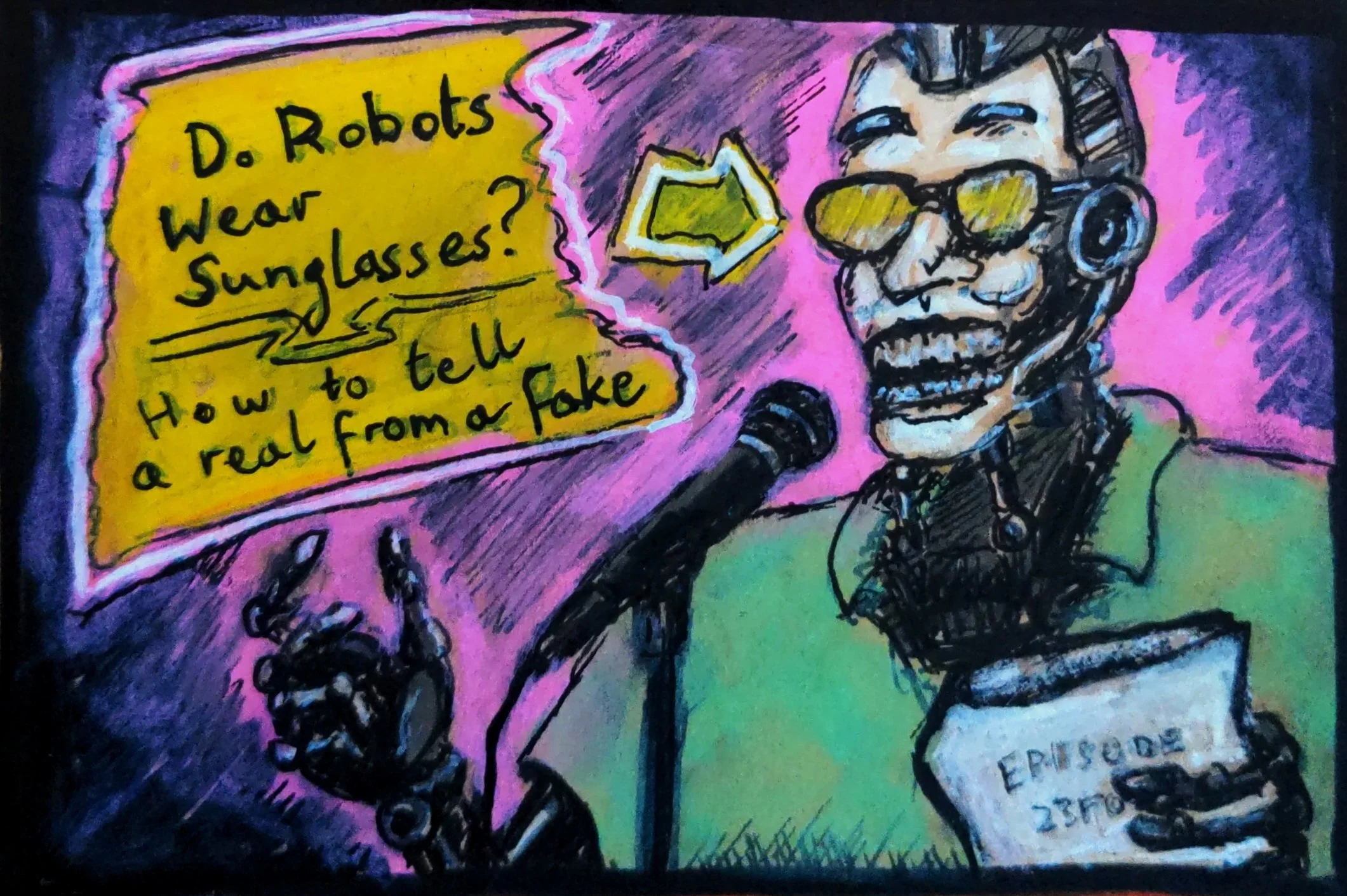
Sunglasses would be an even more superfluous accessory to robots as they are to human. Internal resolution correction for brightness would nullify any danger for dmage to their artificial retinas. Therefore, as robots increasingly mimic human appearances, you should be able to spot someone as a real human if they are searing sunglasses. Inverting Terminator2 logic. AT least until they learn the need for disguises, meaning they are being programmed to deceive people. Maybe that will be the secret ingredient to make them indistinguishable from humans. Just a thought, don’t take it too seriously.
The Simpsons are celebrating another episode milestone, this NYPost article has speculated on the possibility of AI replacing humans in voice-acting on the animated show. The technology is there, however the humans still possess a trick or two beyond AI’s capabilities:
The technology to replicate the show’s voices actually already exists. AI researcher Tim McSmythurs built voice modeling software which can replicate people or characters based on a few hours audio. Many similar products are already available on the market.
“You could certainly come up with an episode of ‘The Simpsons’ that is voiced by the characters in a believable way,” he told Wired.
But would it be legal? The issue remains complicated. From a copyright perspective, the person who owns the rights to “The Simpsons” (currently Disney) is allowed to reproduce the characters and content, including what is known in legal speak as “derivative works.”
However, it has long been acknowledged who the voice actors behind “The Simpsons” characters are, and should their voices be used elsewhere, such as to advertise a product, those actors could potentially make a legal claim, lawyers have said.
It would also depend on the terms of their contracts and how they are written. The actors also have the powerful actors union SAG-AFTRA on their side, which has been very active in protecting its members against AI versions of people, voices and characters.
Plus, as McSmythurs told Wired, The AI generated version “doesn’t sound as energetic as Homer” when by a human.
And since “The Simpsons” has stuck to a winning formula for so long, it most likely wouldn’t make financial sense to give it up, for either the actors of the network.
Personally I think there’ll be a place for AI in the creative process and, just like with previous technological innovations, it will enhance some possibilities, destroy some others and be a workaround or convenience tool for most.
As someone who did animation shorts once, here’s some of the benefits of AI:
-Variety: If you want to do five different voices representing five different characters, then the fact is that they will all sound a little bit like you. The better voice impersonators can employ various tricks to make one voice distinct from another but it only takes you so far. This is typically why you would hire different voice actors to play different characters.
-Economy: some voice spots are low priority. Fictional stories have main characters, supporting characters and bit-role characters (NPCs if you will, a low-importance person with maybe a line or two tops). If you think your target audience will accept an AI replacement and it saves money/time you’ll be tempted to give it a go.
-Covering for the unexpected departure or absence of one voice actor: Maybe they get sick, die or leave the production and there isn’t enough time to find a human replacement.
-Sci-fi/futuristic tropes. With many artforms, you will tend to see that genres/artist with a philosphical commitment to the modern/new will tend to be more welcoming to a new innovative gadget. EG: futuristic music wanted electronic instruments (Kraftwerk for example) but this isn’t a blanket rule.
Established genres more rooted in tradition may still welcome the arrival of a new gadget that can provide a convenient solution that frees up the workload. Never underestimate people’s eclecticism in either the modern/traditional camps.
-point of entry for newcomers: Whether that be younger people investing in their own tools or older people who never previously had the means to execute their creative ideas, there will be people who’ll be as excited by AI’s possibilities as there are others who are presently horrified by it.
There’ll be resistance, backlash and criticism. It may be me one day, when i find some douche is using AI to copy my stuff and not give me credit. But on the whole, I think anyone creative and determined will still find a way to create. We grow up learning a craft or trade of some kind and our brains get hardwired to want to do that thing. It’s very hard to just say “okay, technology can now do what I used to do myself, so i’ll give up on that whole field altogether”. Chances are you will instead shift and adapt so your skillset can be applied elsewhere. SO your fidgety hands and your fidgety brain can scratch that itch and gratify your soul.
I learned photo-media at uni at the end of the darkroom age and the beginning of the digital age. A lot of very expensive gear I learned on is now redundant. I moved on and now I paint and work on this art-blog. There’s always a day after.
One last point is that the new displaces the old and shifts everyone’s focus and attention. But sometimes those who are “stuck in the past” might paradoxically find themselves one day as a point of curioisity for people in the future who regard their old fashioned ways exotic and hard to mimic.